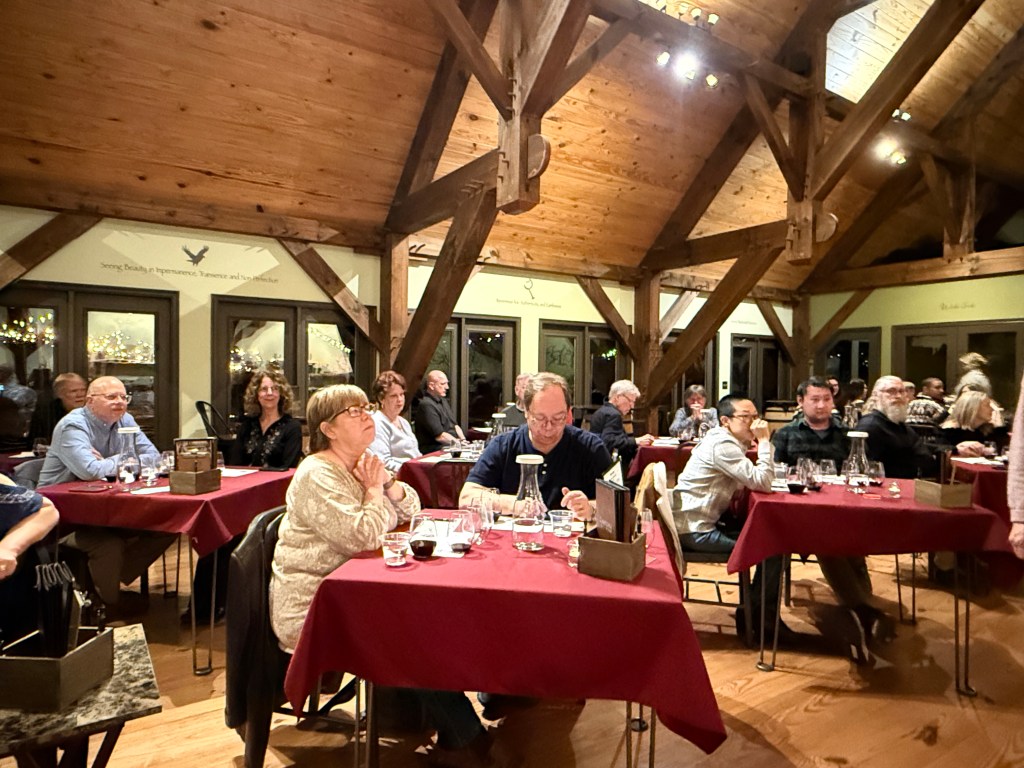
Last week I attended a wine dinner hosted by Arterra Wines. Not only has Arterra consistently been one of my favorite wineries, but this event also featured many of their newest releases. Since I’ve been anticipating tasting their 2023 vintage reds for years, my attendance was practically mandatory.
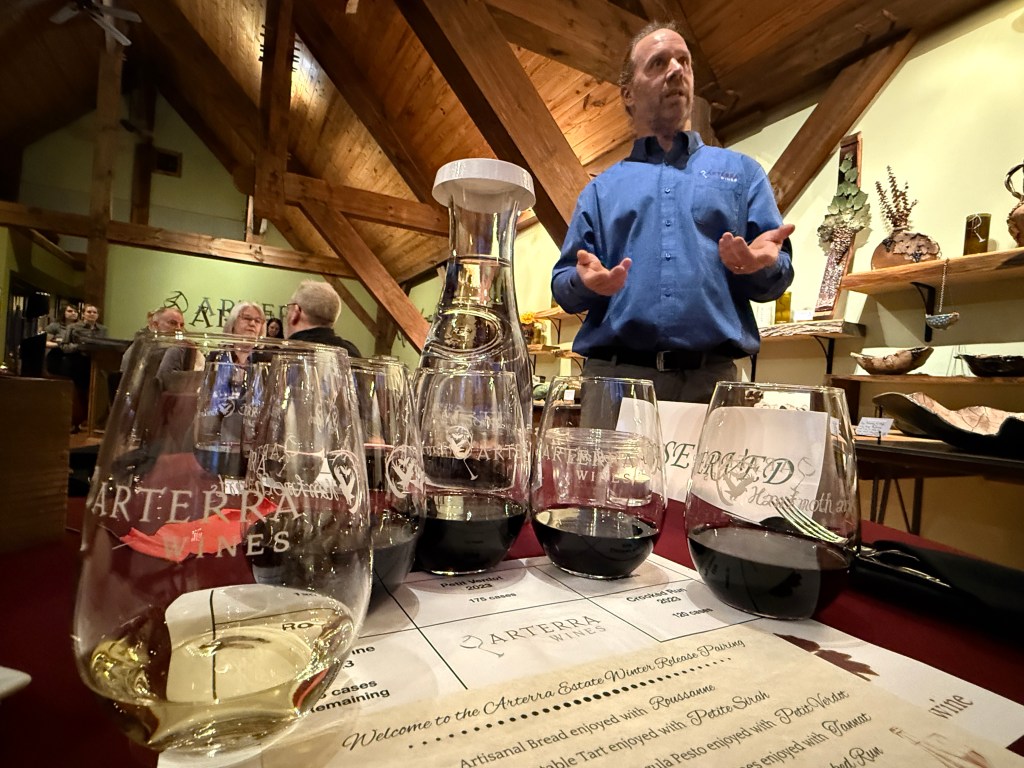
Wine dinners are often a combination of food pairings and education, and this event didn’t disappoint. Owner/winemaker Jason Murray discussed the overall ethos behind his winemaking, as well as the wines being served.
For those who aren’t familiar with Arterra, Jason is one of Virginia’s foremost proponents of minimal intervention winemaking. He’s so hyper ‘minimal’ he frowns on using techniques even other self-described ‘minimalists winemakers’ utilize, and calls his winemaking style ‘clean winemaking’ (which is stylistically similar to ‘natural wine’, although he prefers his wines filtered as opposed to cloudy).
Jason could write essays on what constitutes clean winemaking, but the short version boils down to two things: limited (and more recently, 100% organic) sprays in the vineyard, and the use of natural yeast in the cellar. He also doesn’t use new oak in his wines, as that would insert an external flavor profile.
Limited chemical spraying has always been one of Jason’s hallmarks; the main reason he previously tolerated any non-organic spraying was because for years he didn’t have an effective method to control black rot (a destructive grape disease that afflicts vineyards in warm, humid areas).
Jason started his move to 100% organic farming 2023, after newer organic materials came on the market. When his 1/2-acre trial run proved successful, he expanded his organic program to his entire estate vineyard. As of 2025, his estate vineyard is now fully organic and should receive its organic vineyard certification by 2028.
The other element of Jason’s winemaking is his usage of native yeast. During the event, Jason explained “Yeast is the starting point to either express your site or override that expression to produce wine the way you want to produce it”.
He further explained how his ‘clean winemaking’ style had three main outcomes; 1) wines that produce wine a rounder, broader profile, which is more outwardly expansive on the palate, 2) wines with a richer ‘chewer’ texture, which is especially unusual in dry wines, and 3) his wines have wonderfully fresh, clean finish. These factors were present in the samples we had that night.
The wines he served were from the 2023 vintage, widely regarded as one of Virginia’s best in decades.
Wine and Food Pairing
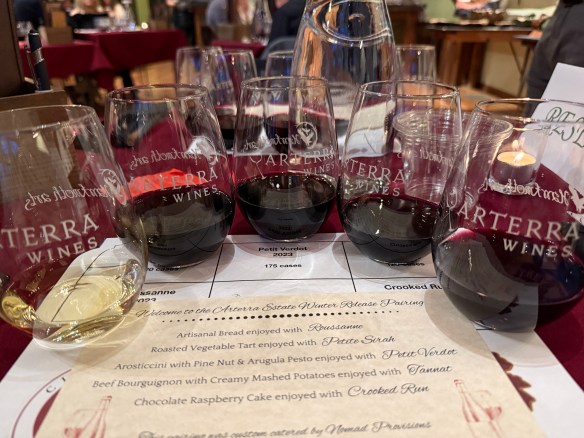
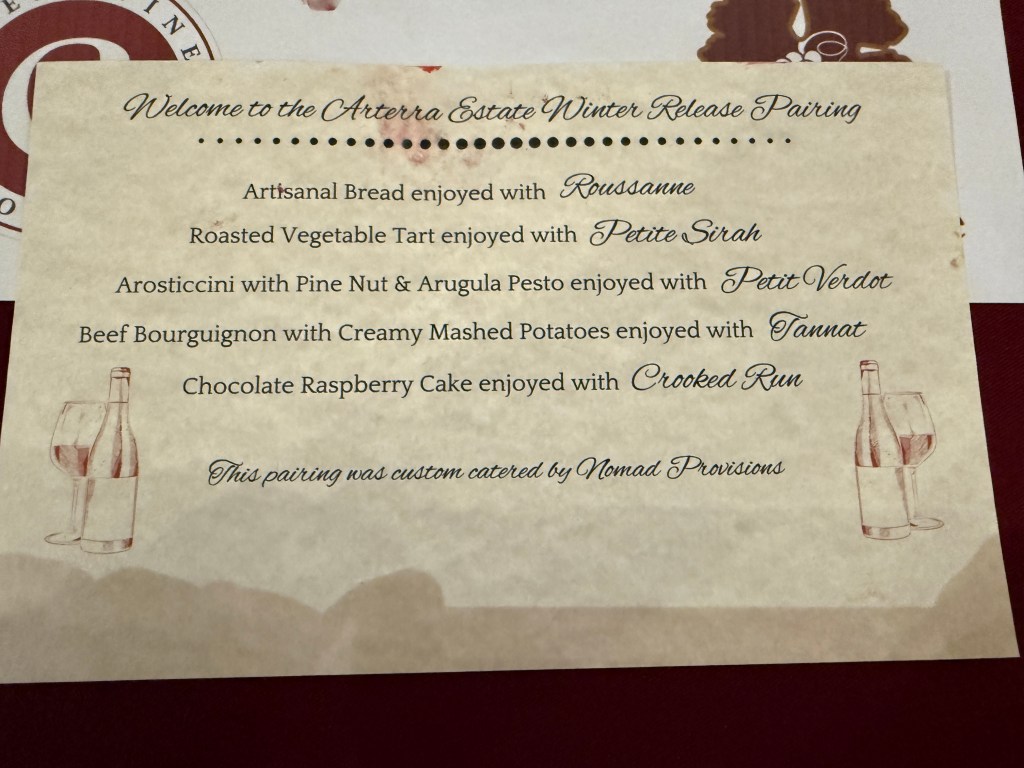
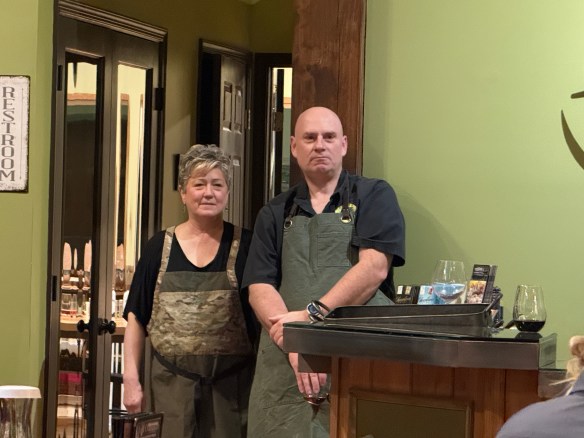
Nomad Provisions were our chefs for the evening. They served a series of small plates and chose the wine pairings for them (Jason was happy to let the food experts select the pairings).
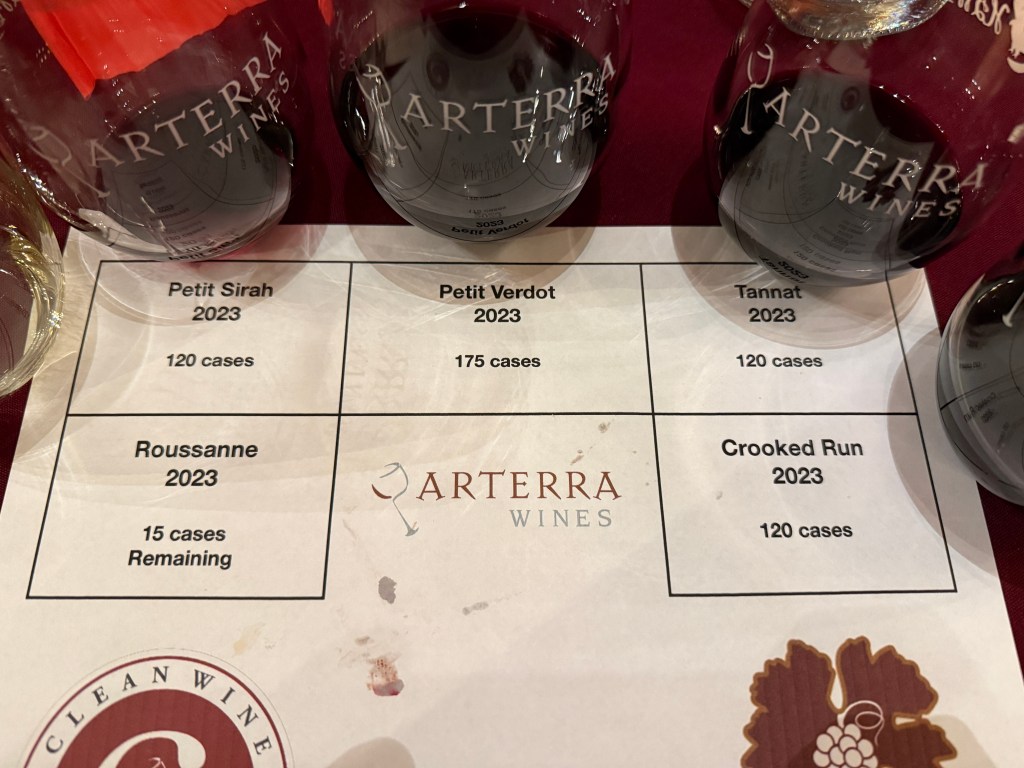
2023 Roussanne (with focaccia bread): Very full bodied for a white wine, with maybe a touch of lemon peel on the palate. Those lemon notes became more expressive the longer the wine sat in my glass. I thought it was a great starter wine, and I assume the high texture was a direct result of Jason’s ‘clean winemaking’ practices.
Arterra is one of the few roussanne growers in Virginia. Ironically, a friend of mine texted me a day earlier praising this particular wine during his visit a day earlier, not knowing I was going to this event.
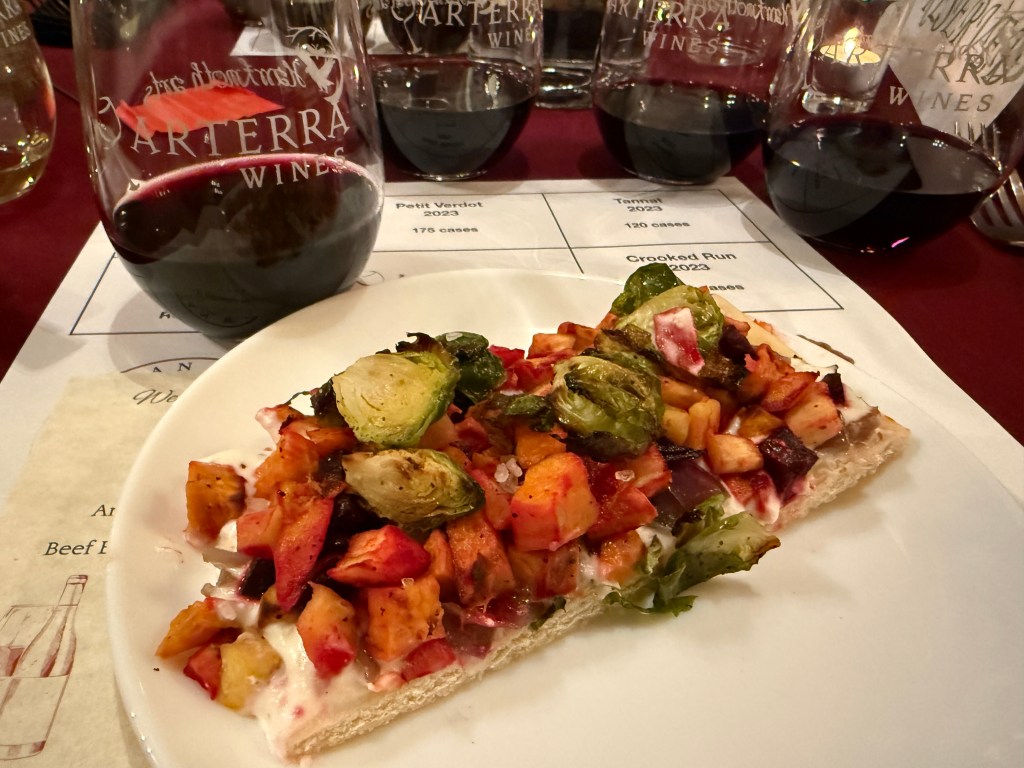
2023 Petit Sirah (with roasted vegetable tart). Juicy and bright, but the tannins were there. I found notes of leather, or perhaps tobacco at the end. This is what Arterra provides to guests who are looking for wine with structure and backbone, like Cab Sauv.
Jason explained Petit Sirah is something of an outlier in Virginia. Apparently, Petit Sirah tends to suck up water so its flavor profile can be very vintage dependent. That said, in the vineyard it’s also become a lot easier to work with once the vines matured. Oddly enough, Jason’s initial Petit Sirah harvests produced huge clusters (the opposite you’d expect from a grape with the name ‘petit’ in the name) but those clusters shrank as the vines matured.
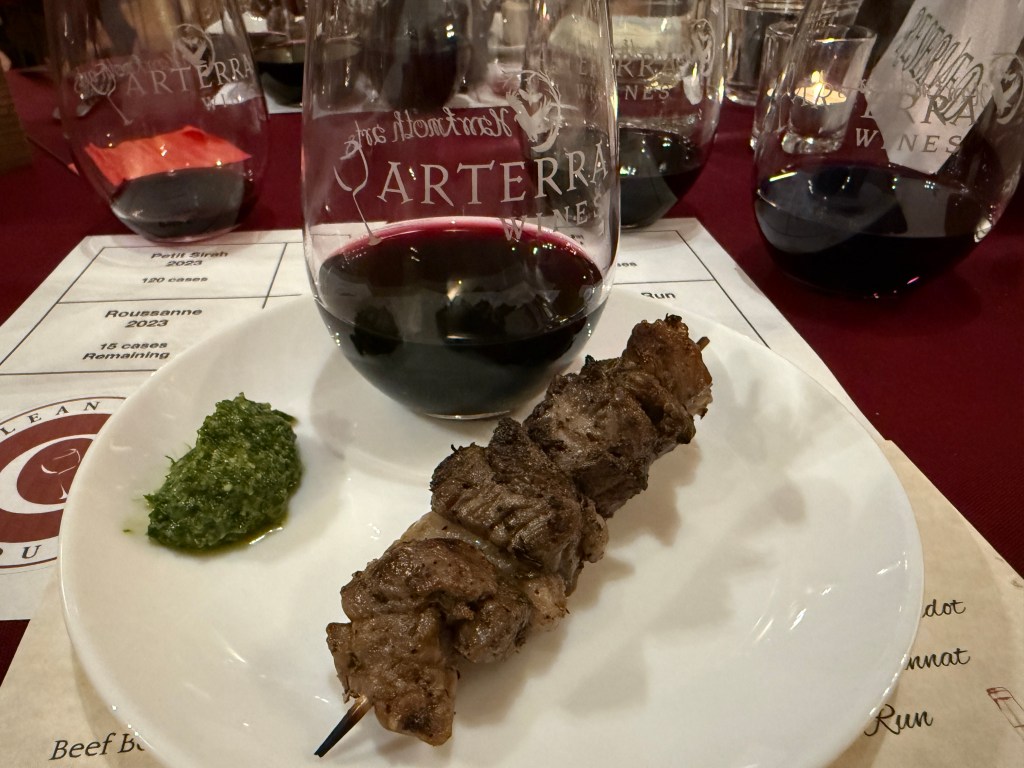
2023 Petit Verdot (paired with arosticcini, and a pine nut & arugula pesto). Hearty and earthy. This is a great grape for Jason’s minimalist winemaking, as it’s one of the most weather hardy vinifera grapes in the state. If Jason could pick out a state grape for Virginia, this would be his #1 choice (note: Jason is not a big fan of cabernet franc, so he admits he’s slightly biased here).
PS – Jason and I both learned that ‘arosticcini’ is just a fancy word for a lamb kabob!
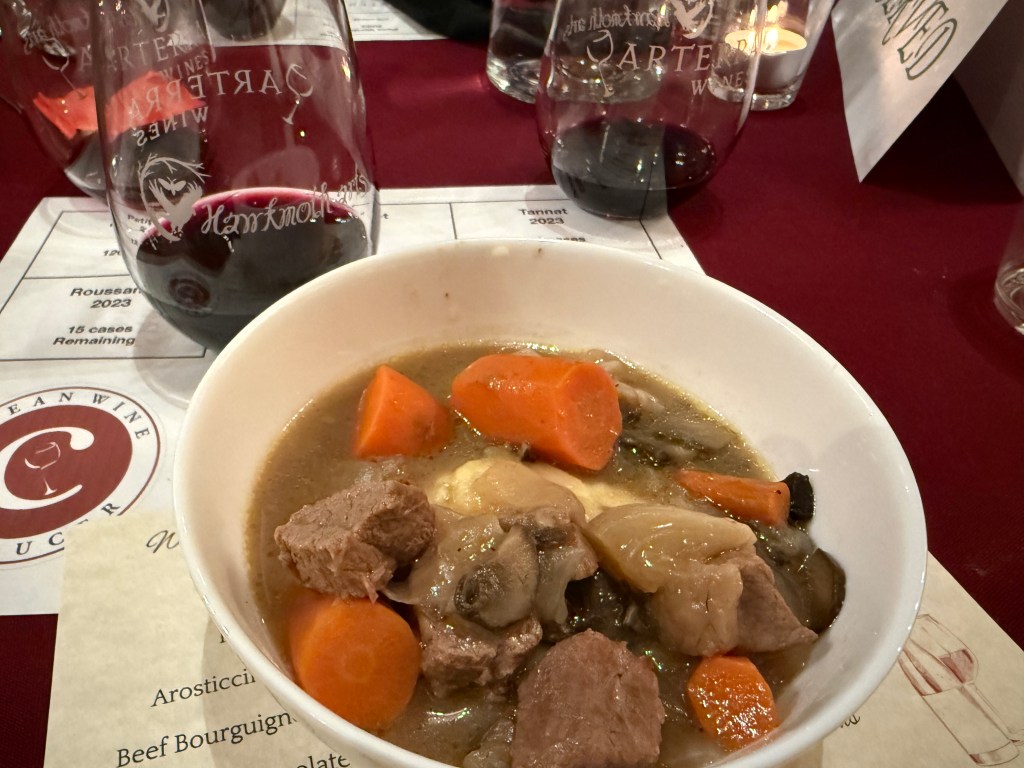
2023 Tannat (with beef bourguignon). If a wine could be described as ‘brooding’, this is it. As it opened, I found notes of black cherry, plus maybe some cola qualities as well. Most notably, there were lots, lots, and lots of tannin.
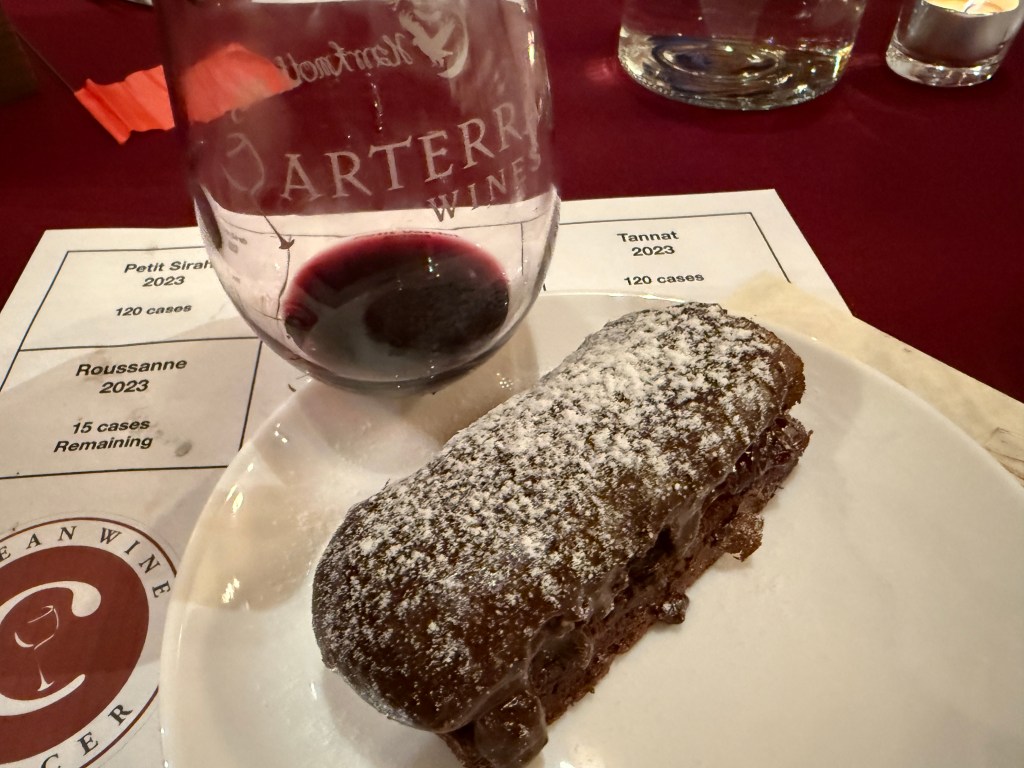
2023 Crooked Run red blend (with chocolate raspberry cake). Also heavy on tannins, but not quite to the degree of the tannat. I kind of wish it had more fruit qualities, but I appreciated how it evolved the most in the glass (in fact, I would say the sampled I tried all evolved quite a bit).
I finished up with a Chardonnay, which like the roussanne had a lot of intensity for a white wine.
I was supposed to be joined by Dan Redding of MyNovaWineBlog, but he bailed on me because this event was rescheduled! We actually tasted the 2023 release earlier in the year, but I get bragging rights for being at the dinner (na-na-nana-na, Dan).
When oenophiles think of events that changed the course of the American wine industry, they’ll likely mention the 1976 “Judgement of Paris.” During that event, a group of French wine judges blind tasted a lineup of American and French chardonnays and red blends, and ranked a pair of Napa wines as the best in both categories.
While not as famous, the Virginia wine industry has made its own contributions to the modern wine industry. Here are a few pieces of Virginia wine trivia that everyone should know.
The Carter Family – Colonial America’s First Internationally Recognized Winemakers
Thomas Jefferson is America’s most famous oenophile, yet he never made his own wine. While he believed America had great potential as a wine region and spent decades trying to grow European grapes, Jefferson’s experiments were constantly thwarted by pests and weather.
Few realize that almost 20 years prior to his viticultural trials at Monticello, the Carter family succeeded where even Jefferson failed.
The Carters were one of the “First Families of Virginia,” a group of early settlers who rose to social and political prominence. Looking to diversify their crops away from tobacco, Virginia farmers were encouraged to plant vines.
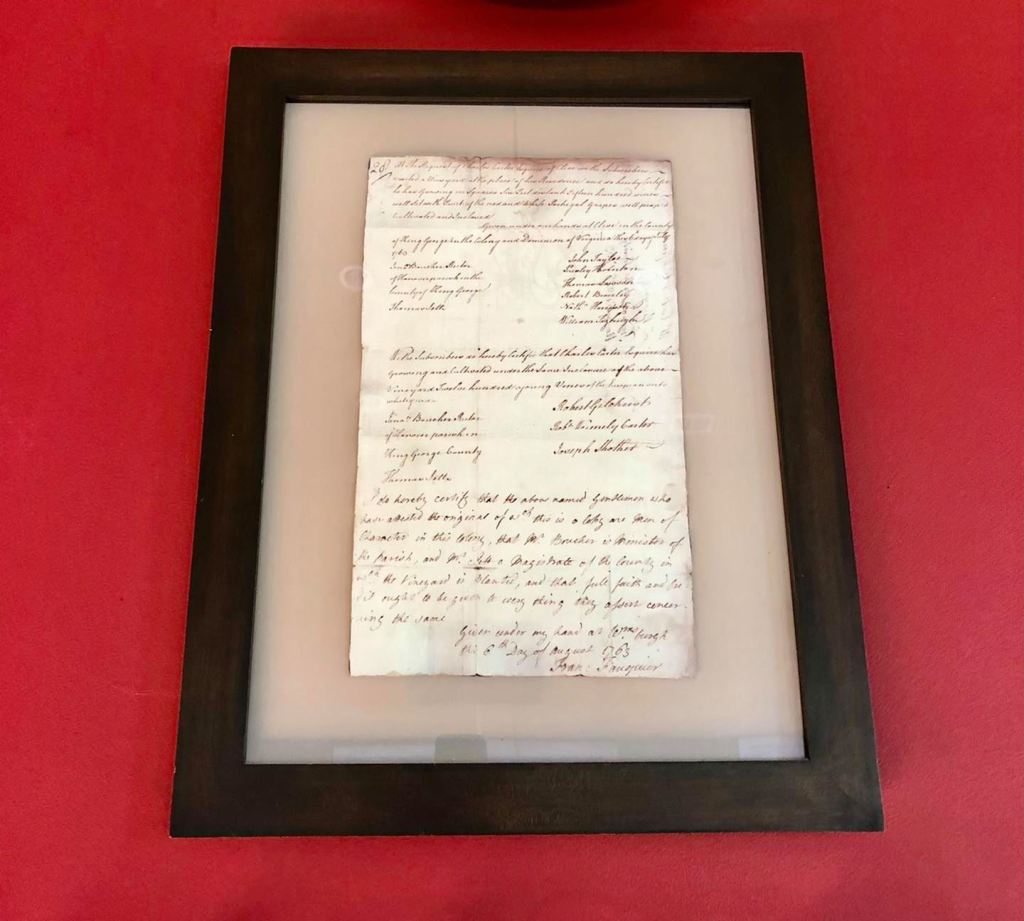
In 1762, Charles Carter sent a dozen bottles of wine produced at his plantation of Cleve (located in today’s King George County) to London’s Royal Society of Arts. The exact grapes he used is unknown, although they likely came from a mix of domestic and European vines.
Impressed with what they sampled, the Society awarded him a gold medal for his “spirited attempt towards the accomplishment of their views, respecting wine in America.” A year later, the Royal Governor of Virginia certified that the Carter family successfully grew European grapes.
The Carter family’s vines were short-lived, likely the victim of the same issues that beset Jefferson. Nevertheless, the Carters were the first successful winegrowers in Virginia (if only for a few years), and possibly all Colonial America.
The Story of Woburn Winery, America’s First Black Owned and Operated Winery
The American wine industry is notorious for its lack of diversity. According to a 2019 survey of 3,100 wine industry professionals by SevenFifty Daily, only 2% of participants identified as Black.
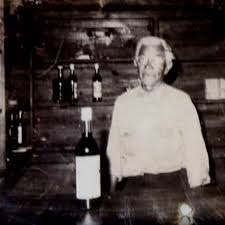
John June Lewis, Sr (1894–1974) was one of the pioneers of this movement, a Black man fathered by a former slave owner and Confederate veteran.
Born in Mecklenburg County, Lewis is listed in the 1910 United States Federal Census as a mulatto servant of Armistead Burwell. John’s son John June “Duckie” Lewis, Jr. previously indicated Burwell was also Lewis Sr’s father, and census records further link the Burwell and Lewis families.
Burwell taught the older Lewis winemaking when Lewis was a child, though it wasn’t until Lewis Sr. was stationed in Europe with the US Army during the aftermath of WW I that he discovered a passion for wine. He would later inherit the former Burwell farm, where he planted 10 acres of vines following the repeal of Prohibition.
This land became known as Woburn Winery, widely regarded as America’s first Black-owned and operated winery. Woburn made wine from native and hybrid grapes for 30 years and closed shortly after Lewis Sr.’s death in 1974.
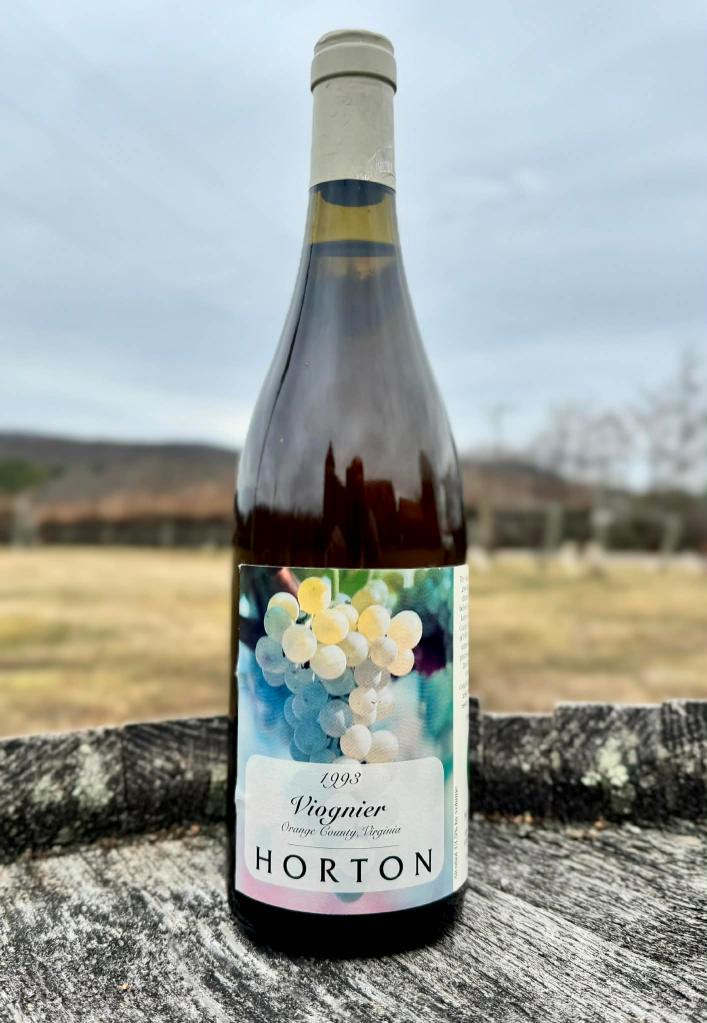
Horton Vineyards’ 1993 Viognier – The Wine That Helped Put Virginia On The Wine Map
The 1990s were a time of experimentation for the Virginia wine industry. Vineyards were finally reappearing after a long prohibition-induced absence, and information on how to grow vinifera (European-based grapes) in Virginia’s humid weather was scarce.
Few embraced this spirit of experimentation as passionately as Dennis Horton of Horton Vineyards. According to granddaughter Caitlin Horton, “My grandfather really didn’t like chardonnay. He wanted a white that he could pair with heavier food. While traveling in France he found viognier in the Rhône valley and fell in love with it. So he planted 14 acres off the bat – didn’t even do a test planting. People thought he was crazy.”
At the time, viognier was essentially dying out. When Jancis Robinson wrote Vines, Grapes & Wine in 1985 she could only identify records for 80 acres planted in the entire world, most of it in viognier’s home of Condrieu.
Dennis’s intuition paid off. Horton’s 1993 Viognier won first place at a California wine competition, providing Virginia some of its earliest national recognition as a wine region. The Napa-based French Laundry (one of the most esteemed restaurants in the United States) took notice, and selected it as the first Virginia wine to have a place on their wine list.
Horton’s success not only gave a publicity boost to the nascent Virginia wine industry, it was also instrumental in saving this grape, which now has around 40,000 acres worldwide.
Looking at recent press praising American Cabernet Franc as a single varietal wine, you’d think this grape has only now been ‘discovered’ by US publications. In 2025 Wine Enthusiast declared “Cabernet Franc is in its “It” Era”. Other articles praise Cab Franc for losing its image as a grape that’s “Always the bridesmaid, rarely the bride” (a reference to how CF is a relatively minor player in Bordeaux).
The reality is winegrowers on the East Coast have long seen Cabernet Franc as one of their signature grapes. For example, New York wineries have become so enamored with this grape they recently instituted a “Cabernet Franc Forward” initiative to highlight its success.
As much as I love the idea, I believe NY is only now recognizing what Virginia has known all along. Cabernet Franc is one of the East Coast’s most reliable, versatile grapes.
Virginia has 629 acres of Cabernet Franc, as reported in Virginia’s 2024 Commercial Grape Report. Cabernet Franc is so important to local viticulture these acres comprise 18.5% of total wine grape plantings in the state (by contrast, it’s barely over 0.5% of California’s total vineyard acreage). It’s also been Virginia’s most widely planted wine grape since 2019.
When I asked Pearmund Cellars winemaker Mark Ward to explain Cabernet Franc’s appeal in Virginia, he put it like this:
“Cabernet Franc is well suited to Virginia from a growing perspective with thicker skins and looser clusters, important factors due to Virginia’s humid weather. It also ripens earlier, avoiding potential late-season rains. It’s flexibility in the cellar reflects a winemaker’s style while still allowing it to be approachable early from the consumer’s viewpoint.”
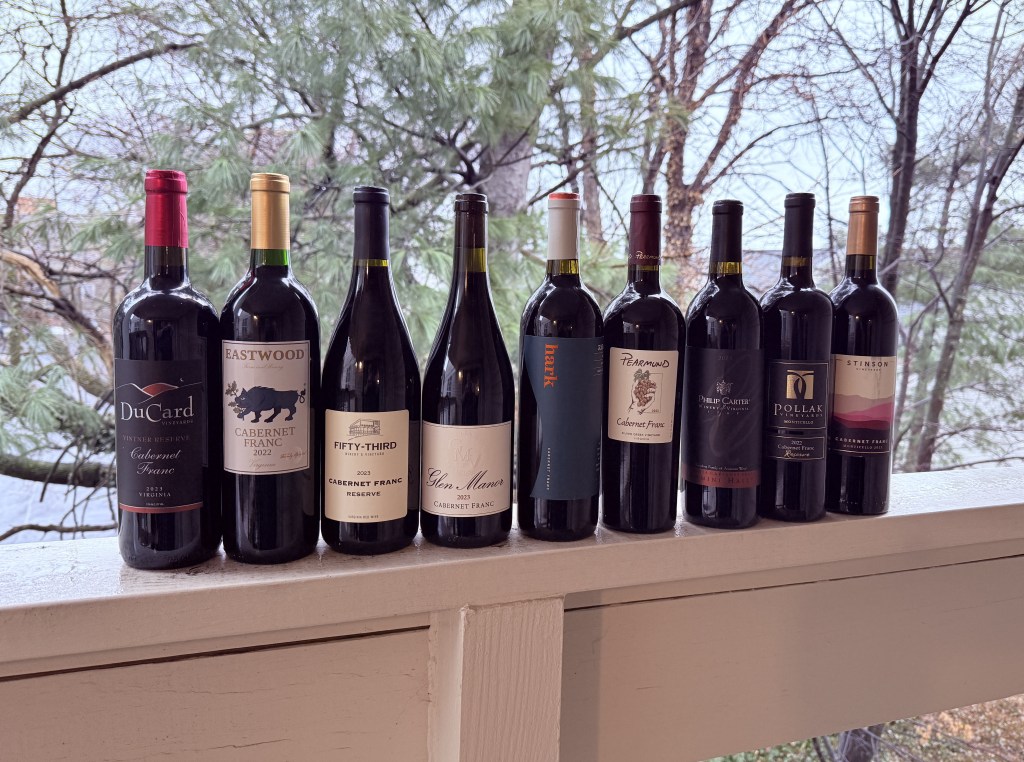
Not shown is the 2022 Early Mountain Vineyards “Shenandoah Springs”
Tasting & Scoring Methodology
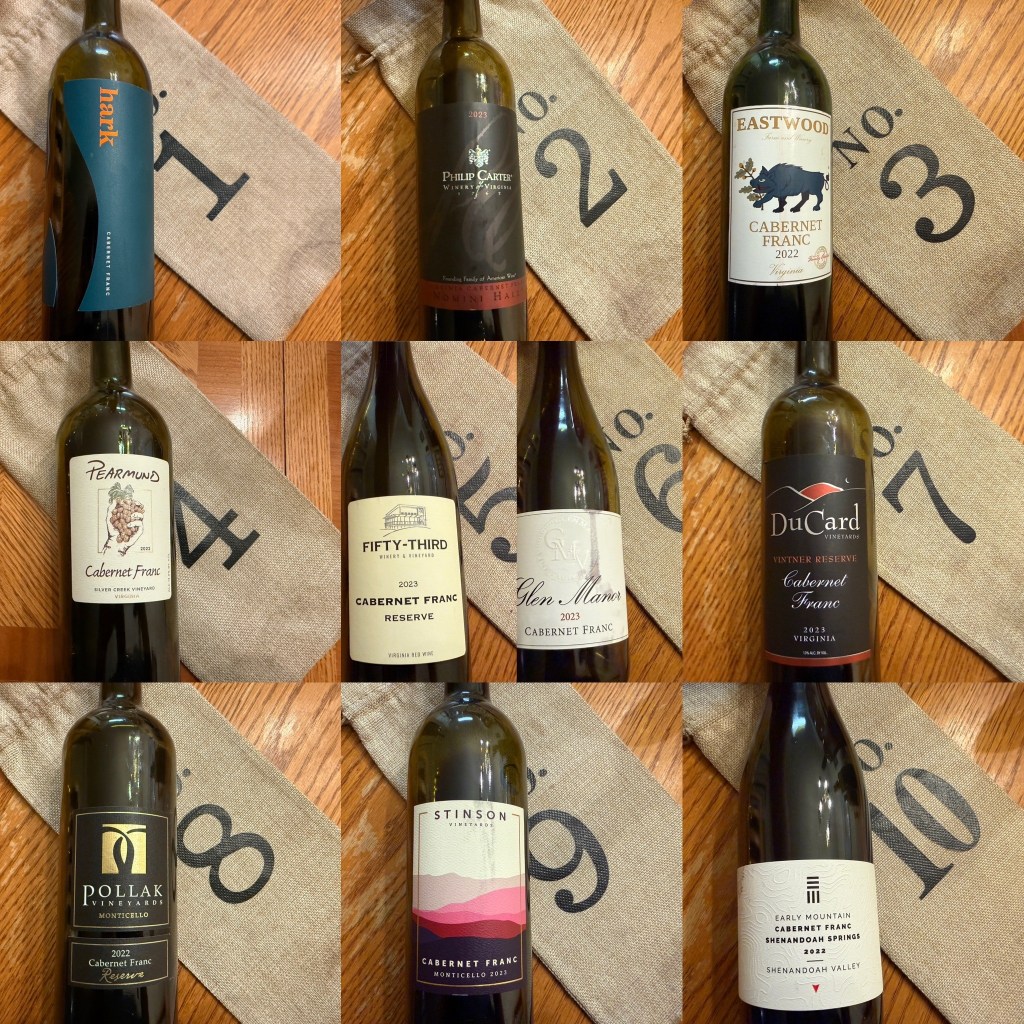
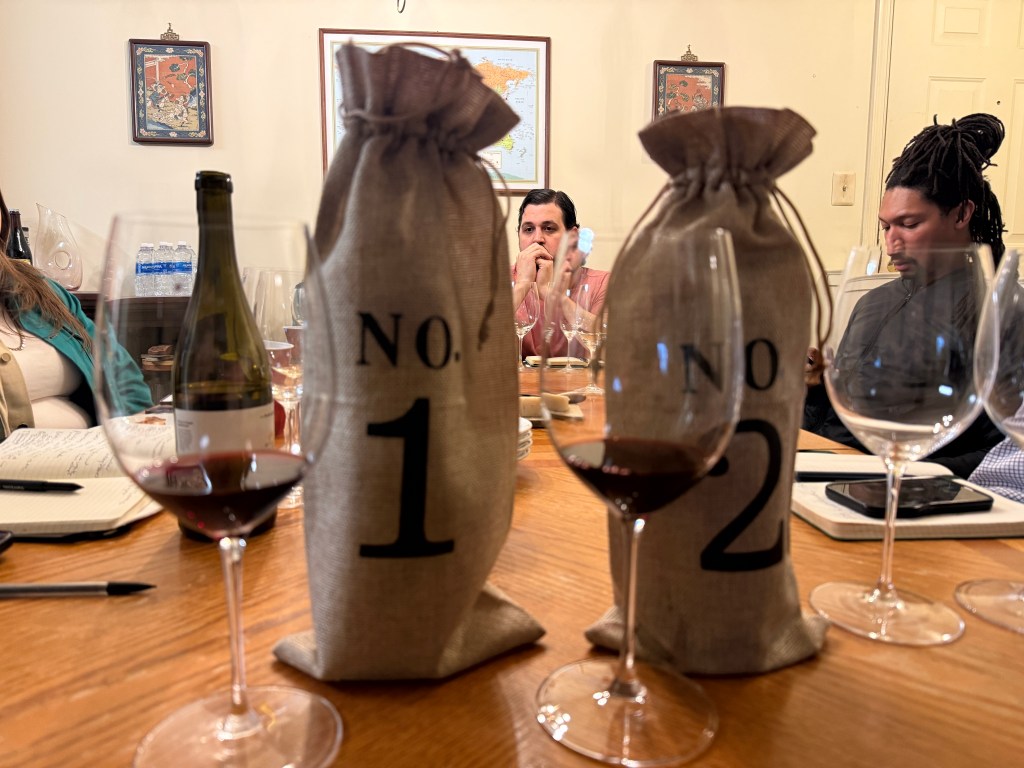
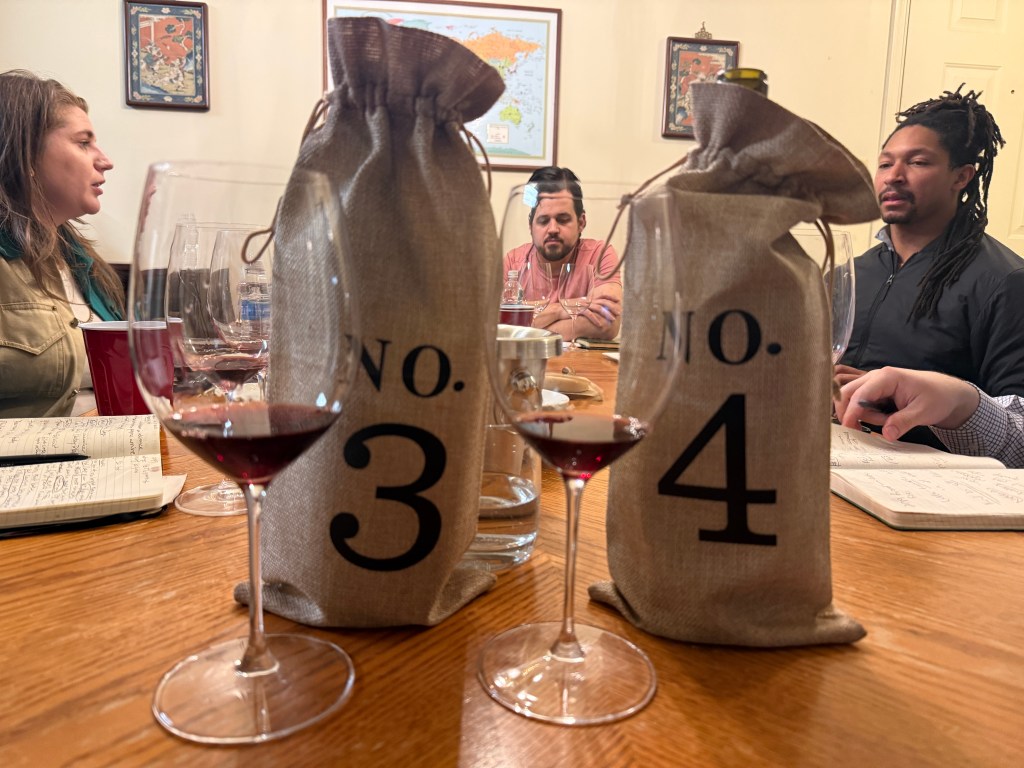
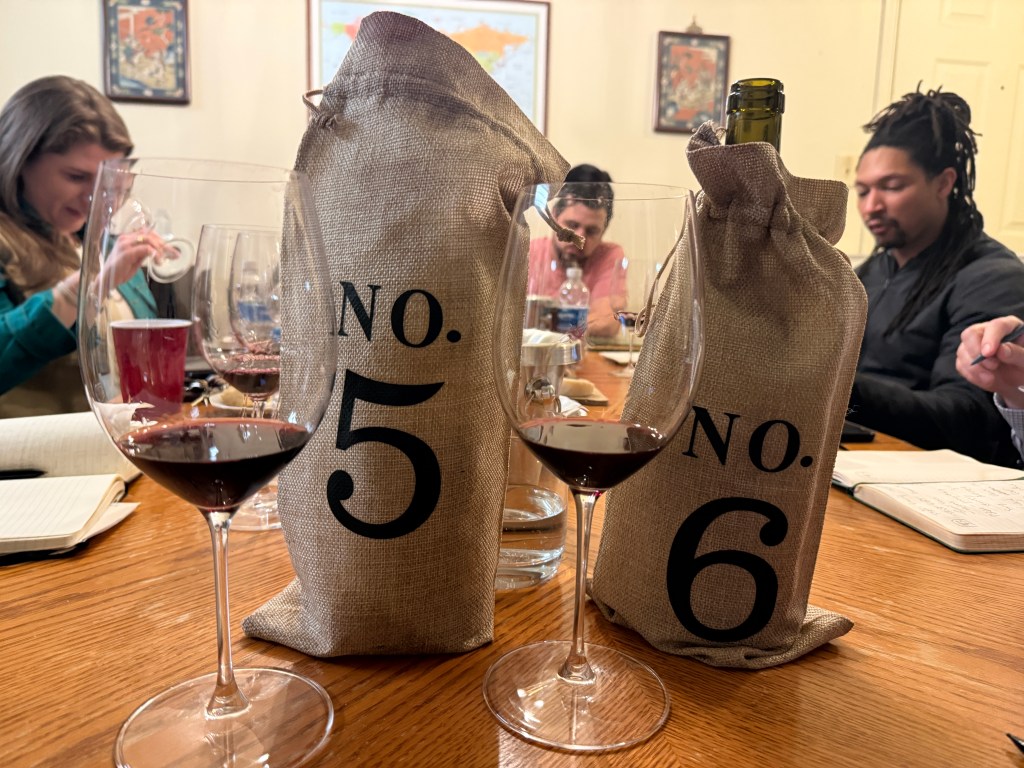
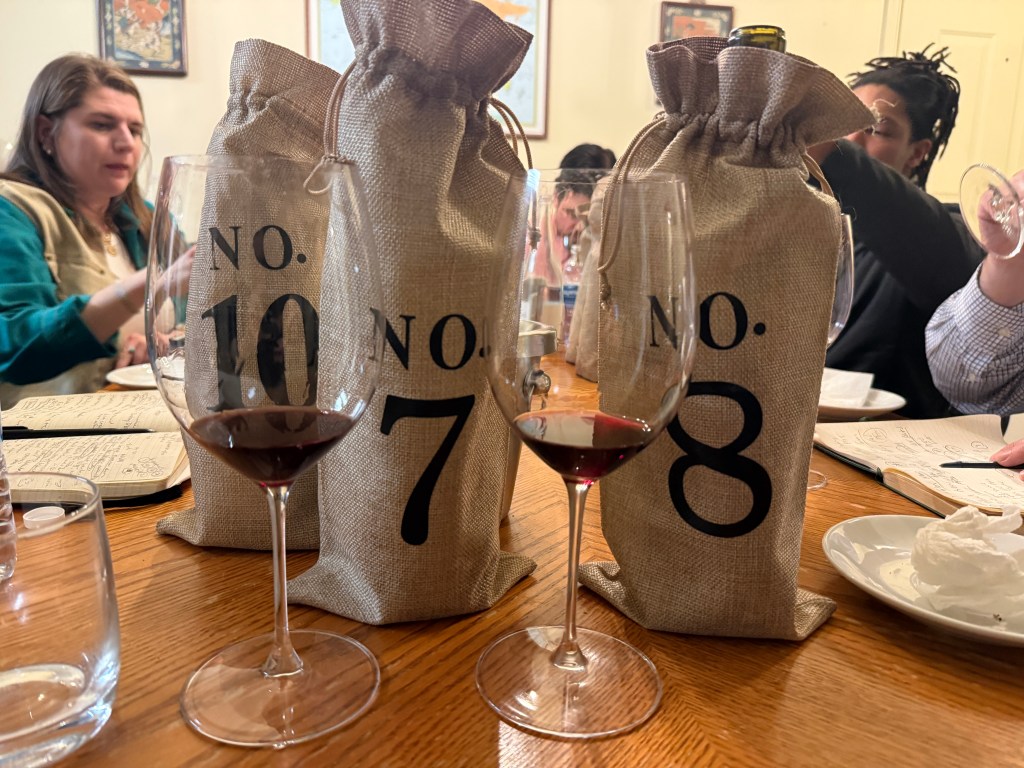
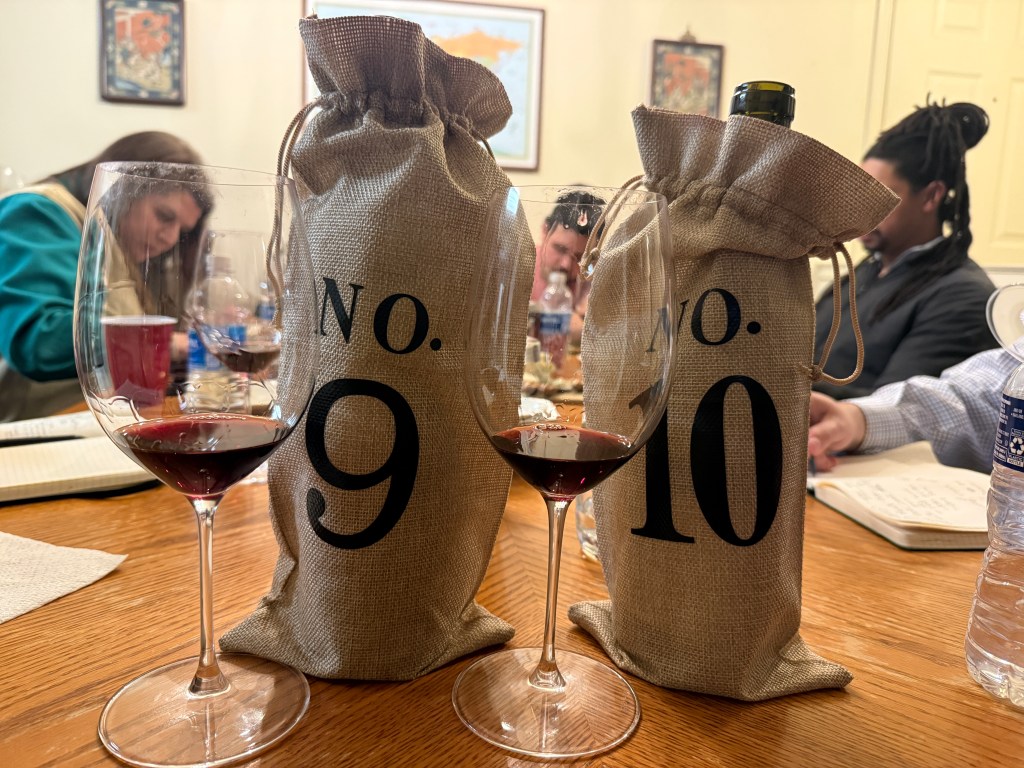
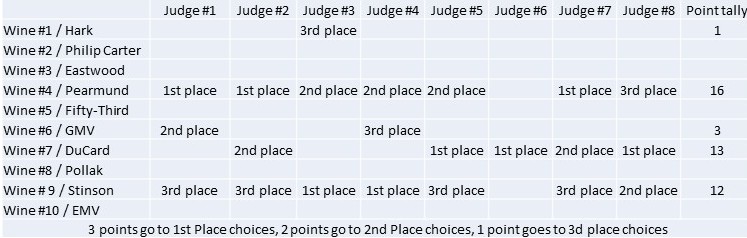
My group blind tasted 10 wines in 5 flights. All the flights were bagged blind (even to me).
The makeup of this particular group of tasters was a bit unusual for my events. While many of my blind tasting participants are already wine professionals, this particular comparison included 5 guests who work as professional somms in DC restaurants or wine stores. While all were broadly familiar with Virginia wine, many of the producers I featured were unfamiliar to them (note: around half these wines were industry gift samples).
One thing that stood out was how important ‘typicity’ was with this group. This was in line with something Matthieu Finot of King Family once told me, that Cabernet Franc must retain varietal characteristics such as pyrazines in order for it retain its ‘soul’. Without those markers, Cab Franc becomes just another red wine.
I specified the goal was for everyone to pick a ‘drink now’ personal favorite, as opposed to selecting wines that met the technical specifications for what should be the ‘best’ wine in a judging lineup. I use this method because that’s how most everyday drinkers choose their wines.
That said, I think the ‘favorites’ skewed towards wines that were more stereotypically ‘Cab Franc-y’, which is important in understanding how we voted. After typicity, the somms tended to focus on balance and integration. I heard more discussions about structure and alcohol levels at this event than probably any other tasting I’ve hosted.
For this event I used a new format. We went through all 10 wines first, then took palate-cleansing sparkling wine break before the ‘finals’.
For the finalist round, I put all the wines on the table to allow re-tastes, then had participants give me their “Top 3” wines.
The Contenders
2023 Hark Vineyards
2023 Philip Carter Winery “Nomini Hall”
2022 Eastwood Farm
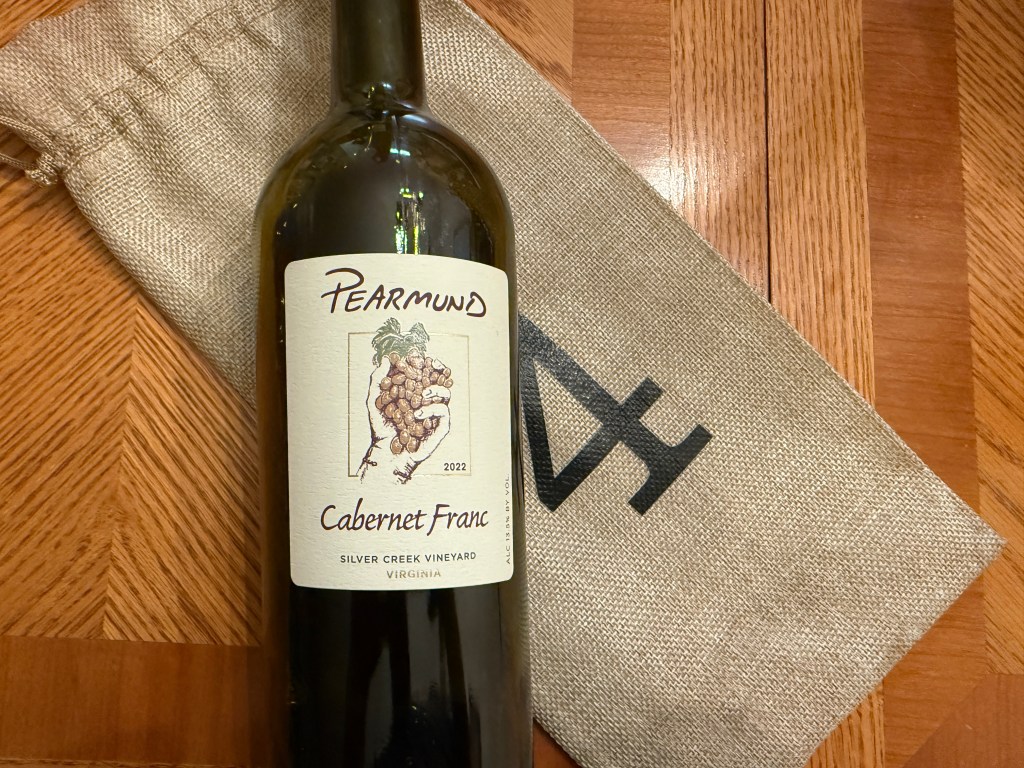
2022 Pearmund Cellars
2023 Fifty-Third Winery
2023 Glen Manor Vineyards
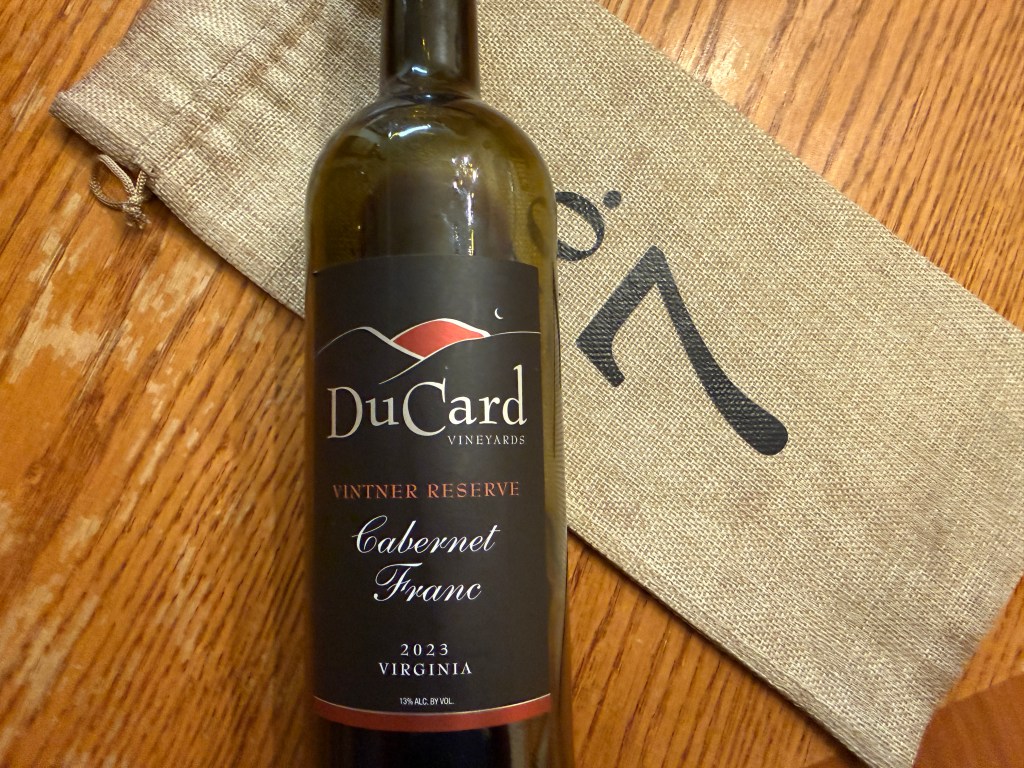
2023 DuCard Vineyards Reserve
2022 Pollak Reserve
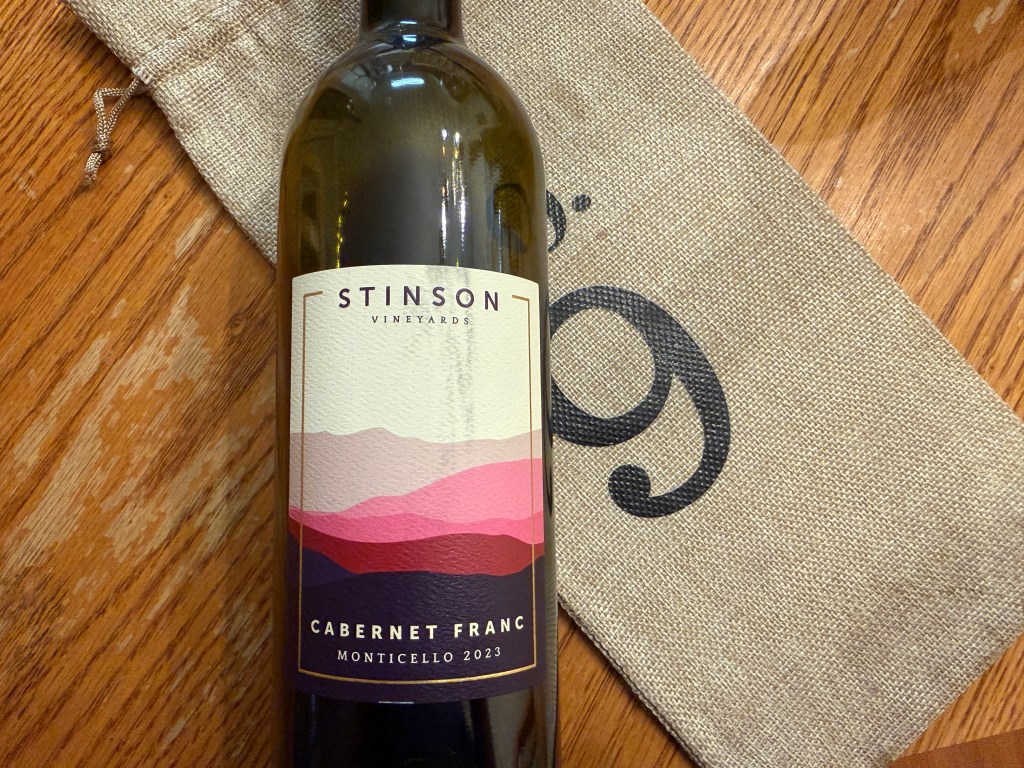
2023 Stinson Vineyards
2022 Early Mountain Vineyard “Shenandoah Springs”
Flight #1
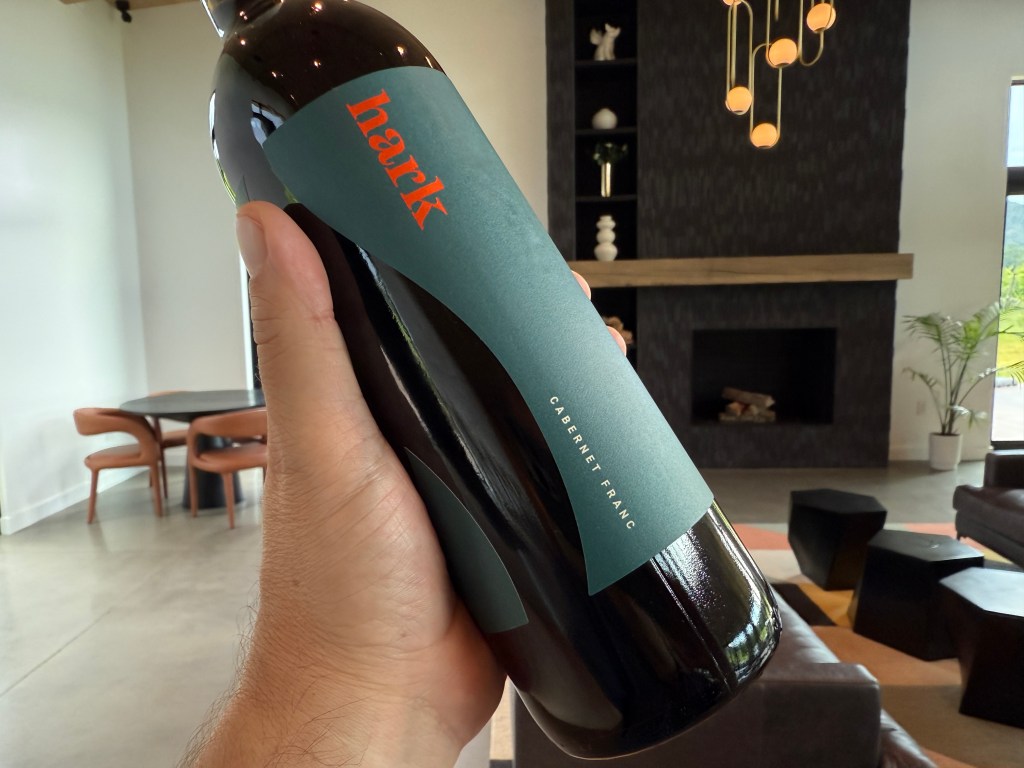
Bottle #1 / 2023 Hark Vineyards: This wine had ‘soul’. People loved the aromatics, and noted it had a roasted pepper finish. Others mentioned the red fruit notes, and someone said it had a ‘stem-y’ note as well.
More than anything else, I heard praise for the winemaking style being very clean and fresh.
Bottle #2 / 2023 Philip Carter“Nomini Hall”: This struck us as an ‘old world’ wine (note – Matthieu Finot of King Family made this, so it tracks). It was hard for us to judge initially since it took a long time to open up, so some of these notes came at the end when we did re-tastes.
I felt it had a confectionary note to it. Others in my group mentioned red pepper and pyrazine notes, but we mostly discussed black fruit (especially before it fully opened). Other notes included a pickled spice note and tarragon. Another participant called out a savory note, “sandy” tannins were integrated, and the wine having ‘tension’.
Comparing the two, #1 was more red fruit, higher in acidity, and more obviously “New World” compared to the black fruit and “Old World” quality of #2. The Philip Carter wine was riper, had a longer finish, and had more complexity when we re-tasted it at the end of my event.
Flight #2
Bottle #3 /2022 Eastwood Farm: Note of Brett on the palate, sharp acidity. I wonder if I had an off bottle, since this was a Double Gold winner at the 2024 San Francisco Chronicle wine competition.
I heard notes of stewed black and red fruit, cacao, coffee notes, and it was richly textured. Another participant said there was some juicy red fruit on the palate, although the Brett and acid did overwhelm them.
Bottle #4 /2022 Pearmund Cellars: There were more notes given to this wine than perhaps any other of the day. I heard ‘roasted chili and ‘pecan chili’ called out. It was denser than #3 but still balanced. Aromatic, with tart, ripe fruit on the palate. “Long tannins” were mentioned several times.
Overall, this was just a super approachable, elevated wine. I had ‘floral’ underlined in my notes because that was the most popular description. A lesson in balance.
Flight #3
Bottle #5 / 2023 Fifty-Third Winery: Red fruit on the nose. I heard notes of bay leaves, spice, dried fruit on the palate. There was a hot note here; several felt the higher level of alcohol put this wine out of balance. Even so, the flavors were there. It also had an earthy quality to it.
I didn’t get a lot of notes of black vs red fruit, as much as this wine seemed to deliver a moderate level of both.
Bottle #6 / 2023 Glen Manor Vineyards: This wine encouraged a lot of debate. Everyone noted it was a well-made wine, but tasting it now compared to the other bottles seemed to be do it a disservice. But in 3-5 years, this may have been the winner of the day.
In terms of tasting notes, I heard conflicting notes about where to place it. Someone mentioned it struck them as more of a Bordeaux blend vs a full Cabernet Franc, while another said it was more like a California CF vs a Virginia CF.
The GMV was also very structured, with good ripeness. It had fruit notes, but just as importantly the fruit notes and the overall structure were in balance (balance was a key theme for this group).
I also heard ‘beet root’ and notes of graphite (this was one of two wines in the lineup with any mineral notes to it).
Flight #4
Bottle #7 / 2023 DuCard Vineyards Reserve: This was the most “Cab Franc-y” wine of the lineup. Judges who insist on typicity loved it (apparently, I prefer Cab Francs without the soul of Cab Franc, so I was an outlier).
I say I’m an outlier because I don’t love pyrazines, which were here in abundance. But they were the ‘good’ pyrazines you’d expect in a varietally-correct Cabernet Franc, and those pyrazines didn’t throw anything out of balance.
Other tasting notes included cassis and a smoky-chili pepper note. Tannin was there, which gave it some power. The oak was well integrated. Other notes include black cherry, raspberry, and cola notes, as well a beautiful finish.
Bottle #8 / 2022 Pollak Reserve: Sarsaparilla nose. This wine emphasized oak and tannin, which made it atypical to the Cabernet Francs we sampled that day.
The high levels of these qualities came at the expense of fruit notes. One participant noted that while it had moderate acidity, the high level of alcohol did the ‘heavy lifting’ for this wine. I tasted it 3 days later and it was much calmer. Maybe I should have held this wine for several more years.
Flight #5
Bottle #9 / 2023 Stinson Vineyards: This wine was well enjoyed, but the comments focused on it being more of a ‘red wine’ than a ‘Cabernet Franc’.
Group notes included herbaceous qualities such as tomato leaf and bay leaf. It was ‘plum-y’ but still had a red pepper note. The wine was ripe and soft. The somms praised the oak integration here, which they attributed to excellent winemaking. The floral notes also were praised.
I think it’s safe to say this was the most delicate wine of the day. One person mentioned it had a Pinot-like quality to it, sans the earth qualities (winemaker Rachael Stinson Vrooman is married to Ankida Ridge winemaker Nathan Vrooman of Pinot Noir fame, so there might be some truth to this).
Bottle #10 / 2022 Early Mountain Vineyard “Shenandoah Springs”: This wine was intense.
Someone mentioned it had an almost raisinated quality to it, which elicited agreement from the table. Another noted notes of potting soil. It had a higher level of alcohol than we expected in a Cab Franc. It had ‘dusty’ tannins, but the lack of fruit made it feel a bit astringent.
Finalist Round
Bottle #4: 2022 Pearmund Cellars (Top wine of the day)
Bottle #7: 2023 DuCard Vineyards (Runner Up)
Bottle #9: 2023 Stinson Vineyards (3rd place choice)
I tallied votes from our participants, asking them to vote their top favorite, 2nd favorite, and 3rd favorite wines of the day. To keep tally, I assigned 3 ‘points’ to 1st place choices, 2 points to 2nd place choices, and 1 point for a 3rd choice.
In summary, the 2022 Pearmund Cellars wine was our top choice of the day. It was described as the kind of wine you could put on the table and everyone would enjoy, and seemed to appeal to both judges who wanted something varietally correct, and those who didn’t want something overly Cab Franc-y. “Approachable” and “elevated” were its by-words
While this Pearmund wine was generally felt to be the best wine from a ‘drink now’ perspective, I want to give callouts to the other top scorers.
The 2023 DuCard Reserve was the top winner for those who want something that screams tipicity (note; winemaker Julien Durantie comes from France). One of the somms refused to consider any other wine than this. It came in 2nd overall in terms of voting.
The 2023 Stinson Vineyards was the 3rd top wine of the day for being a stunning red wine (although some naysayers may say it could have been more Cab Franc-y for their palate). The nose was one of the loveliest of the day; almost certainly the favorite of anyone who doesn’t love pyrazines. The oak integration had a ‘goldilocks’ quality of being ‘just enough’.
The 2023 Glen Manor Vineyards deserves a special mentioned for its structure. Its main drawback is we felt it needs more time in bottle. In 3-5 years though…this is going to be stunning. The somms noted that while the price point is high, its age-ability makes it worth that price.
So in a way, there were multiple ‘winners’, depending on the qualities you were looking for.
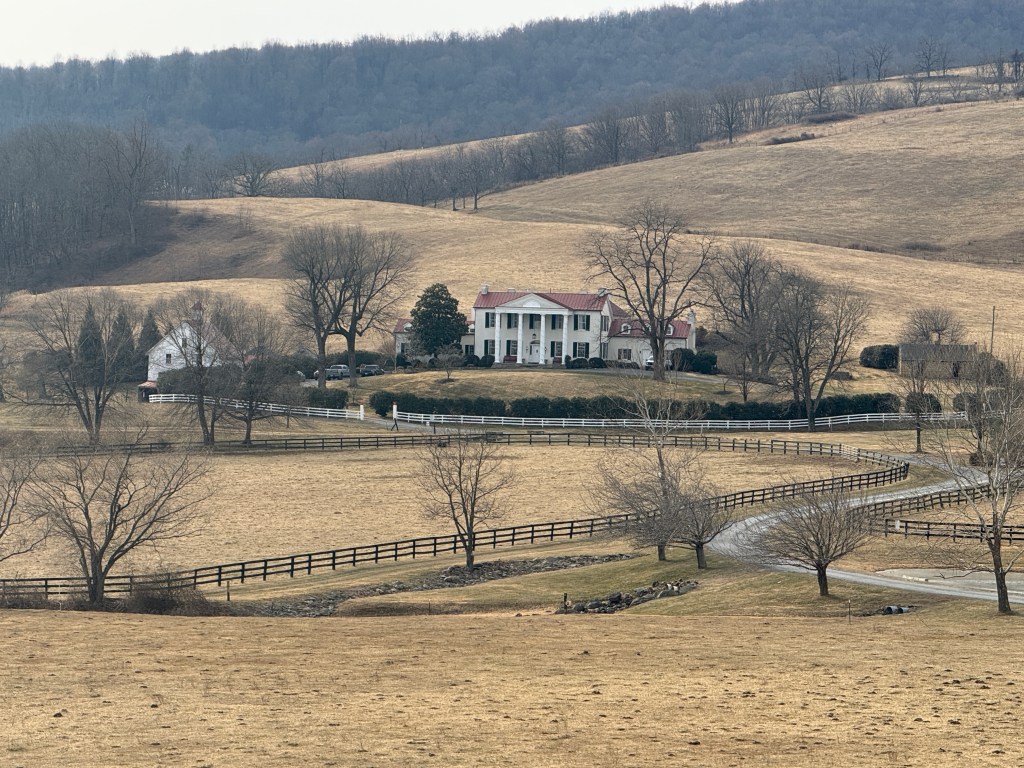
Anyone who’s hiked Sky Meadows Stake Park has seen Ovoka Farm in the distance. Situated on the northern end of the park, the farm’s red-roofed manor home and grain silos have long been magnets for local photographers.
Now, you can actually visit.
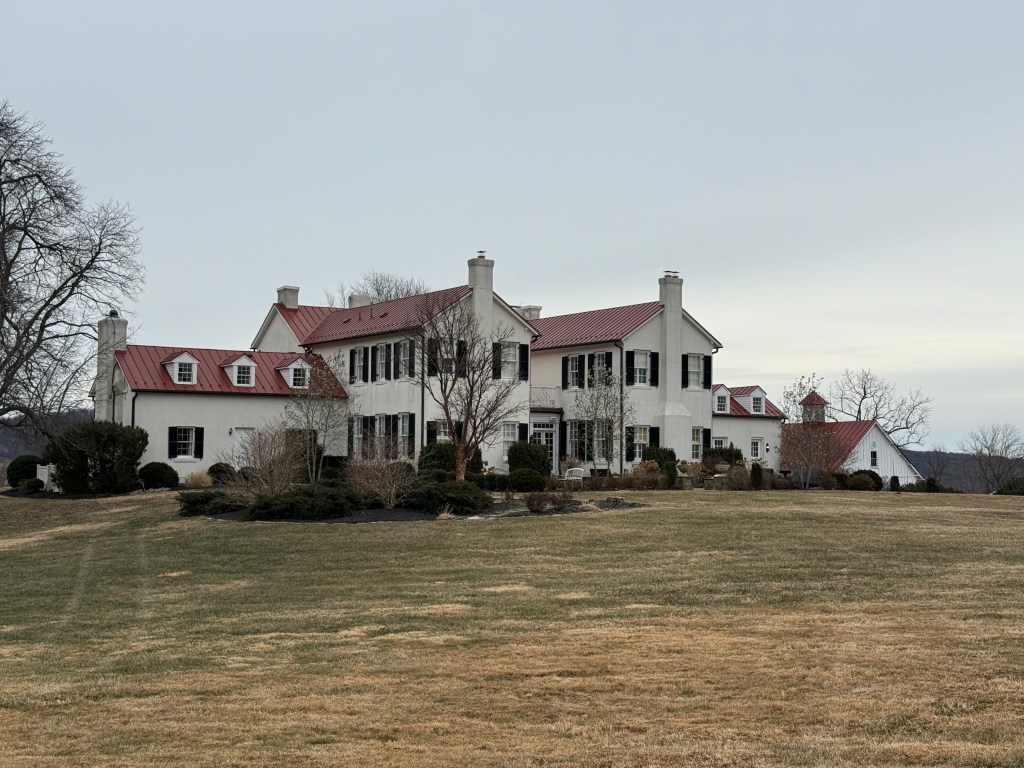
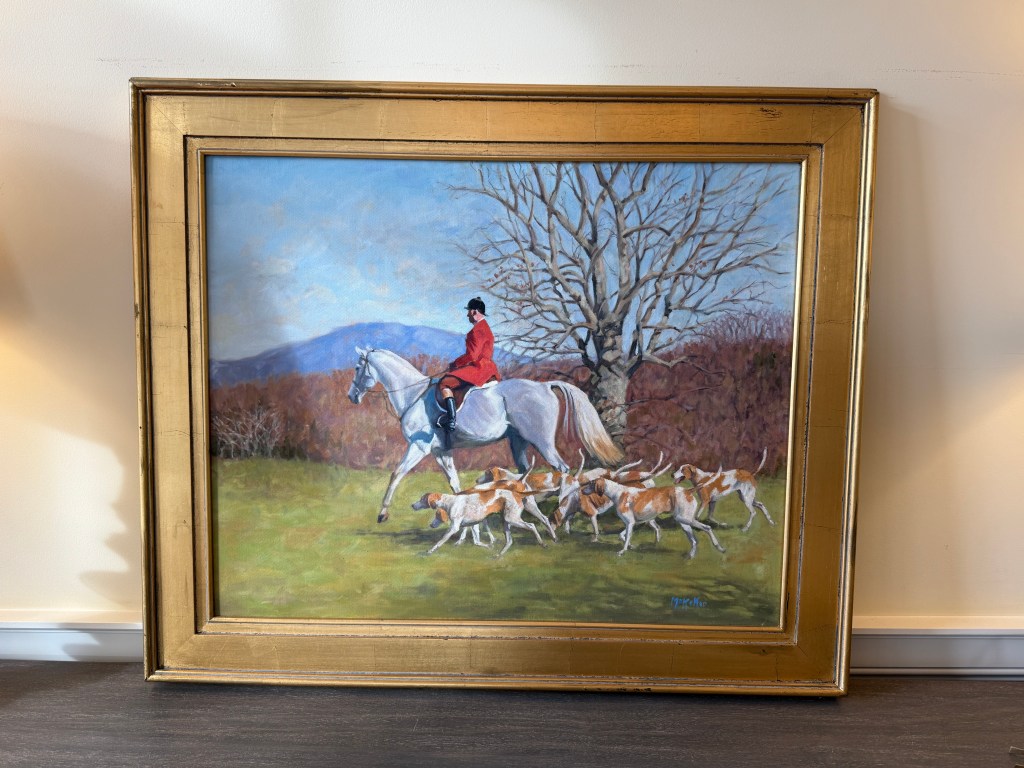
The property has gone through many iterations, ranging from an early 18th century farmstead, equestrian center, and personal residence. In 2012 it was purchased by the current owner, who slowly transitioned into an event space, AirBnB, and wagyu cattle farm.
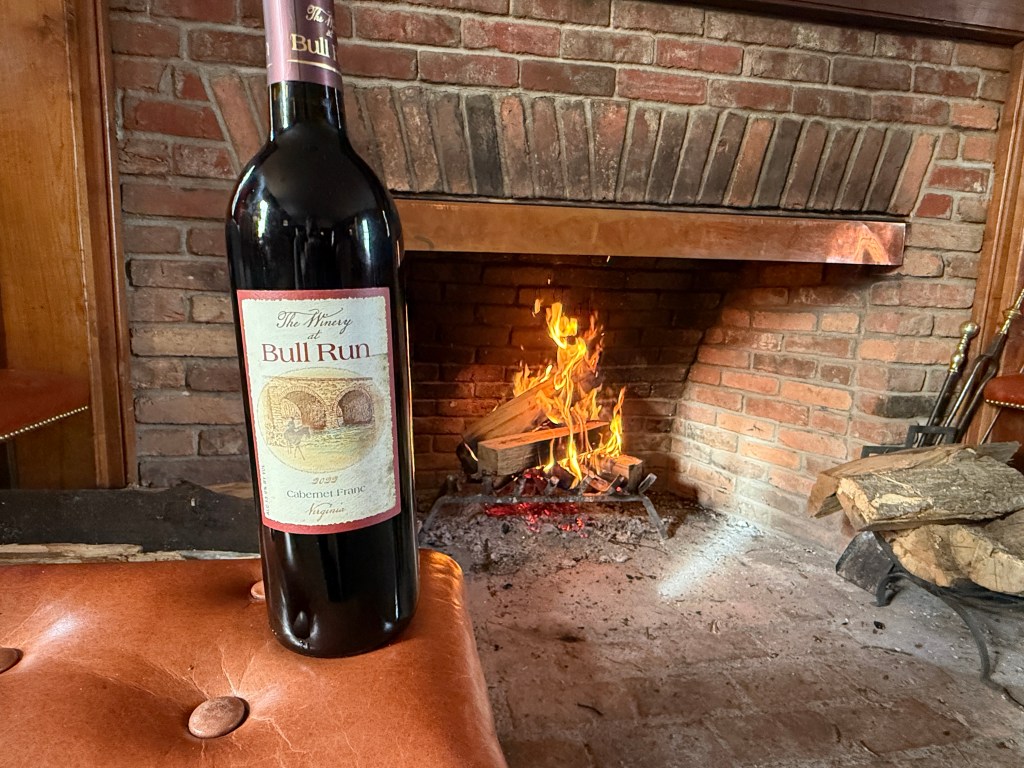
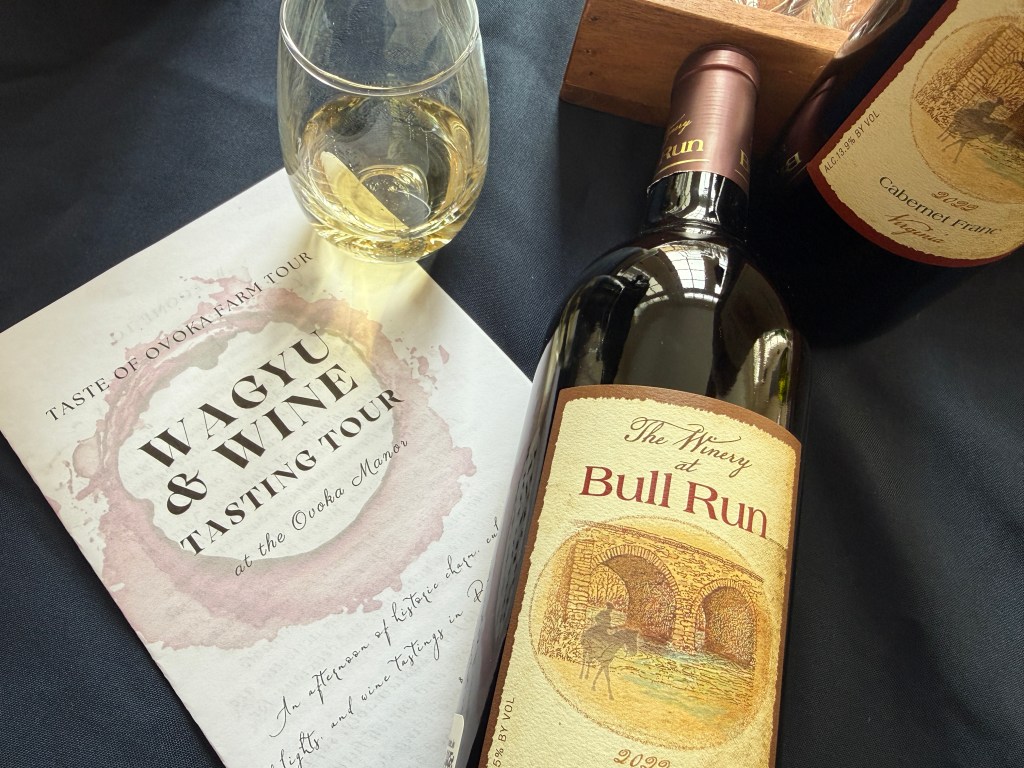
Adding to this series of ventures is its latest initiative; a partnership with The Winery at Bull Run to become a farm winery. I was quick to join their first official “Wagyu & Wine” tour, one a series of events now available on their website.
The Farm and Manor
I’d be remiss to just say ‘it’s an old farm’ and leave it at that.
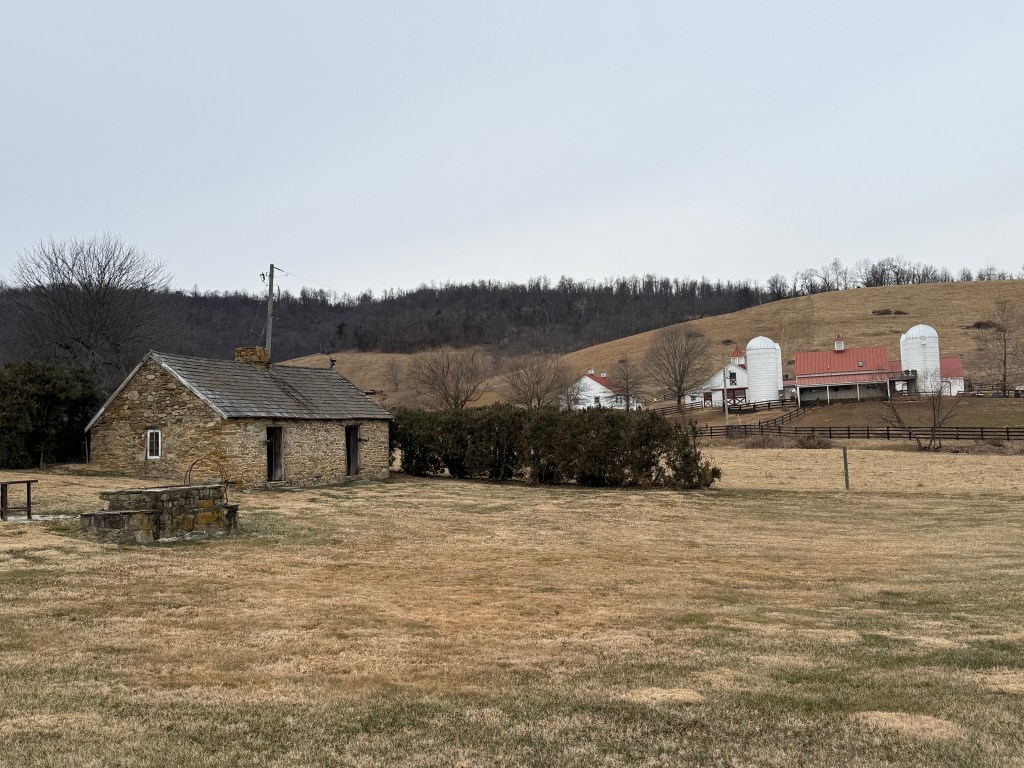
The land was part of an 18th century colonial land owned by Robert Carter, who at the time was one of Virginia’s largest landowners. In 1769 it was surveyed by George Washington, who stayed at a stone building that still stands today. The name ‘Ovoka’ means ‘ever running water’, although the owners aren’t sure what language it originated from.
Today, the farm consists of ~700 acres, including a farm store and a cira-1780s manor home. I came early for photos, which allowed me to stop at their pickup some Shepard’s pie for dinner at their future tasting room.
Owner Karen Wray moved here from Chicago for more space for her family. As the kids gradually moved out, she decided the farm was best suited for raising cattle. And not just any cattle – Japanese Wagyu.
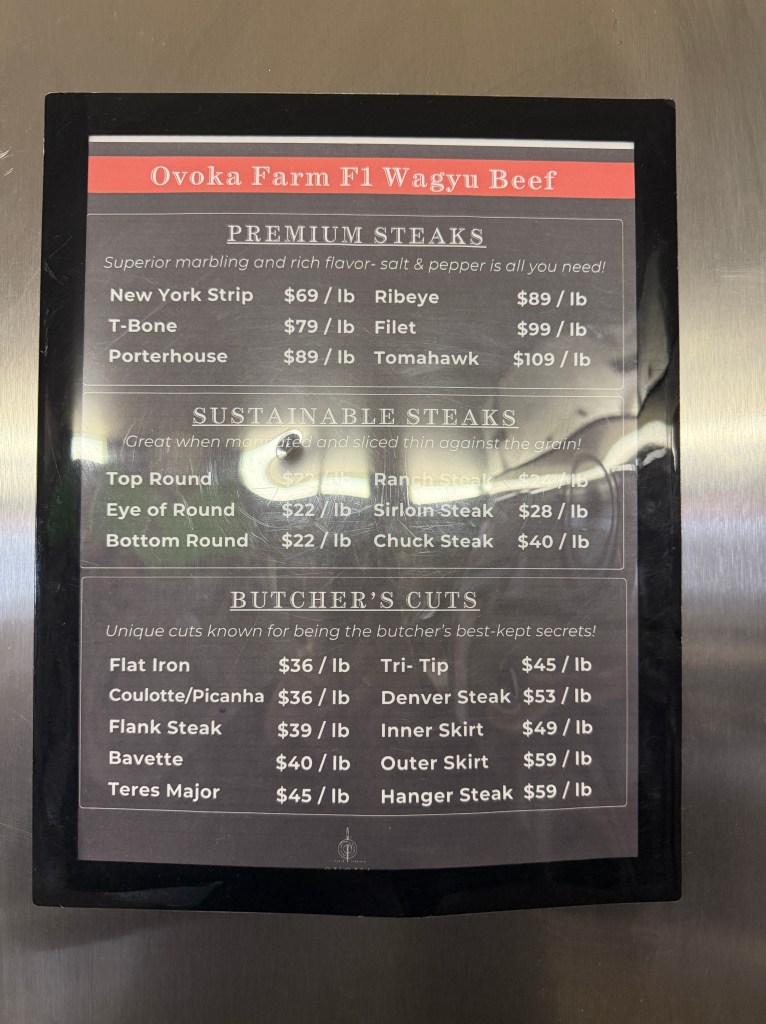
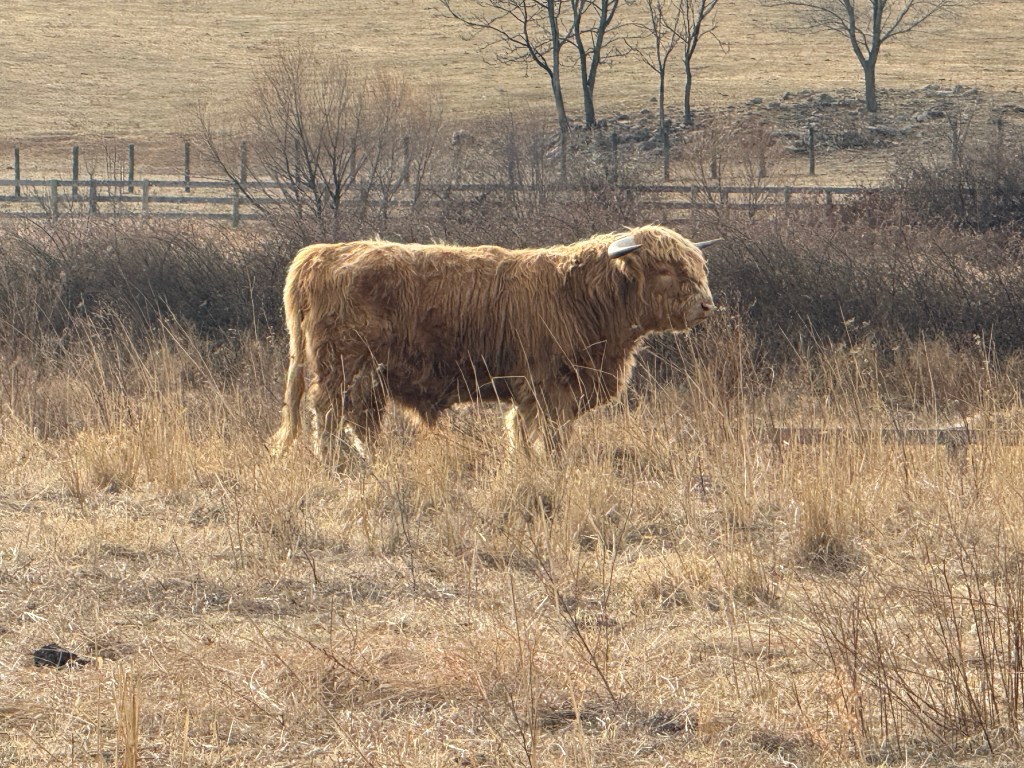
Wagyu beef is prized for its fine marbling and tenderness, the result a low-stress life (you might say they live charmed lives…until their very last day). Chefs love it, and Ovoka sells their beef to an assortment of fancy local restaurants. You can also find it at some farmers markets and their food truck.
One drawback about Wagyu is it’s not easy for non-chefs to cook. To compensate, Ovoka bred their cattle with more traditional American Angus. The 400-head herd is now “F1 Wagyu”, a 50/50 cross with the best traits of both.
GW stayed in the stone building
The Wine and Event
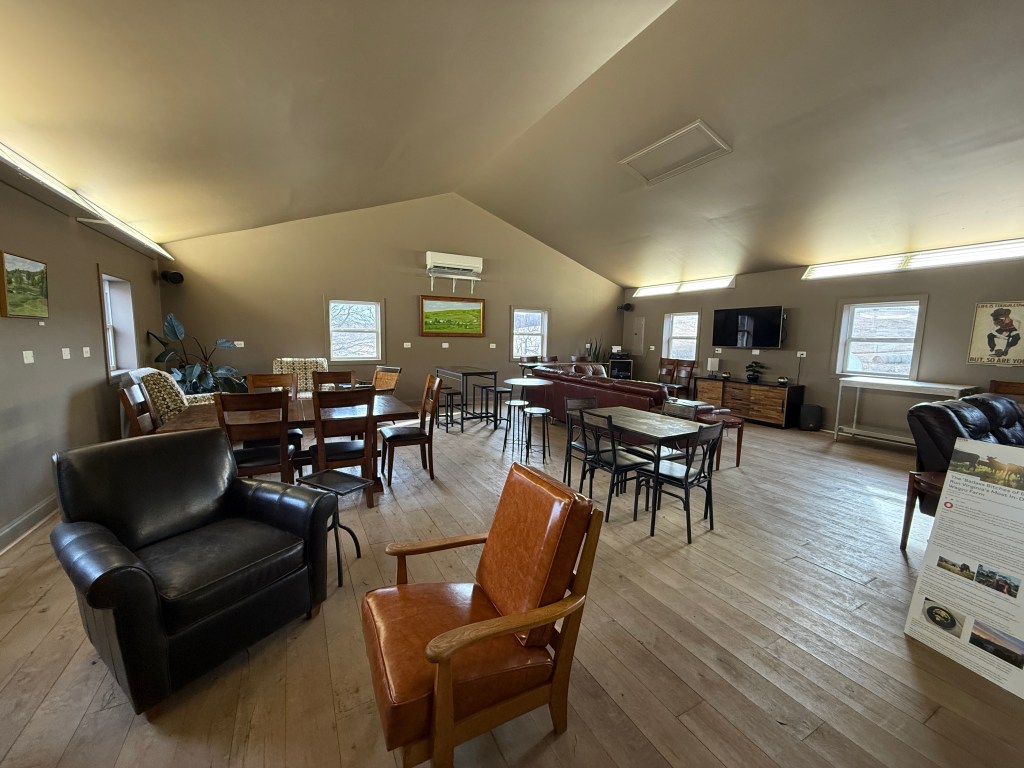
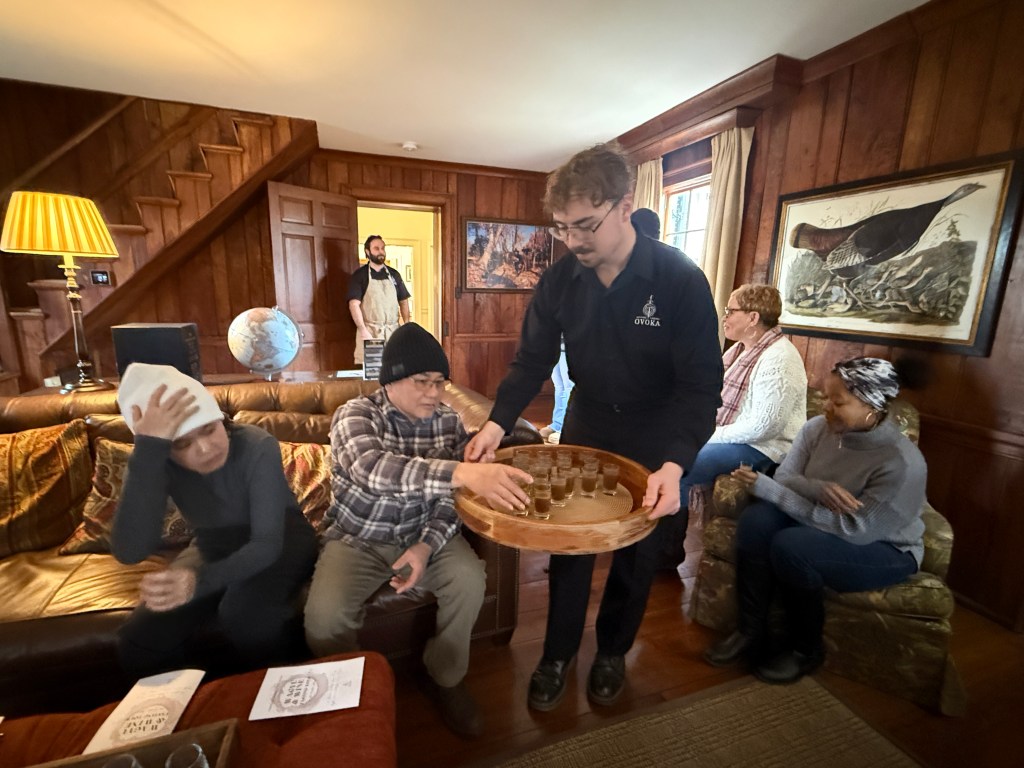
Our event was in the main dining space and den (nicknamed “The Cherry Room”), but guests got to wander around, gawking at the various bedrooms. I also sneaked out to take a picture of where George Washington slept.
Operations Director Mel Freshwater gave the attendees the low-down on the property’s history and their newest direction, then followed up with a series of wine and food paring, highlighting Ovoka’s beef.
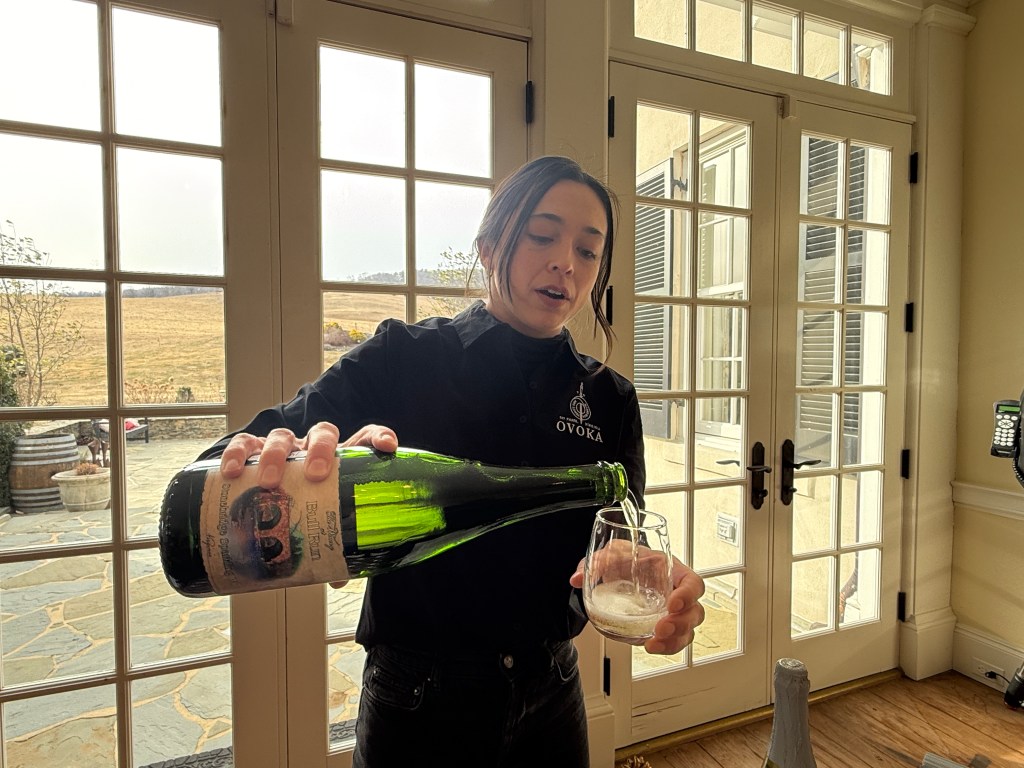
Ovoka doesn’t yet have vines on the property, so in the interim they serve Bull Run wine and rely upon their expertise. Bull Run’s Winemaker Kendell Anderson makes wine onsite for them using Virginia grapes, and Ovoka-branded wine is coming in the future.
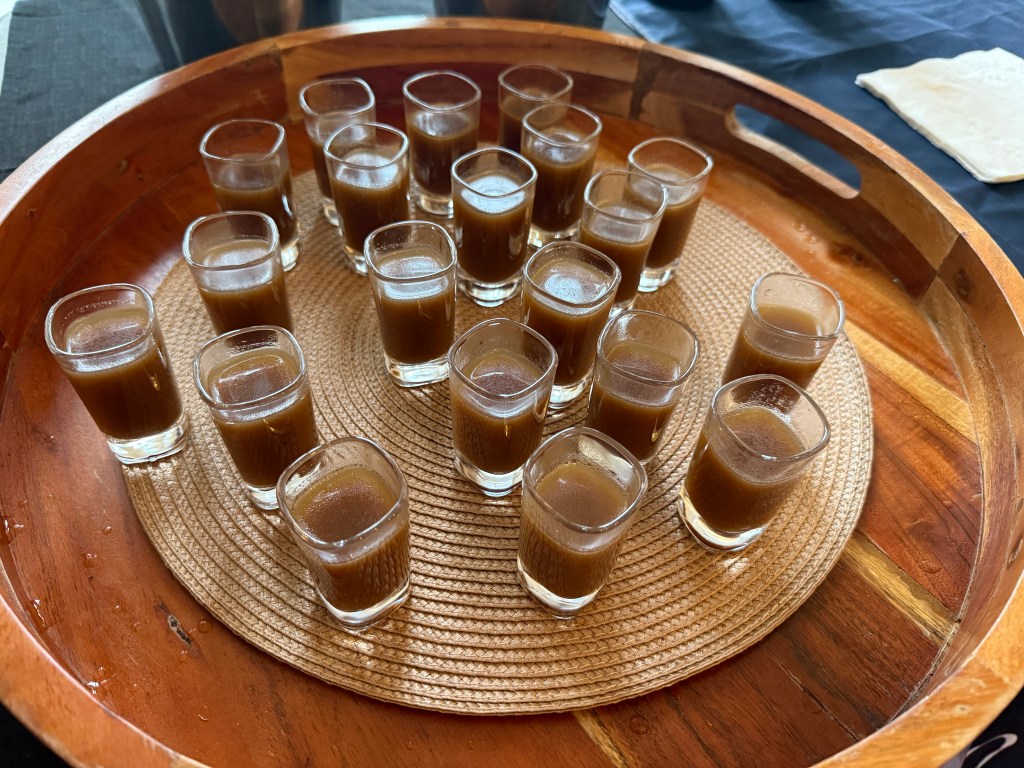
We lounged around next to the fireplace enjoyed our first sampling; a tasty amuse-bouche of beef bone broth made with thyme and cognac. Mel also did a show-and-tell using artifacts from the property (it was good I remember them, since they were part of an informal scavenger hunt).
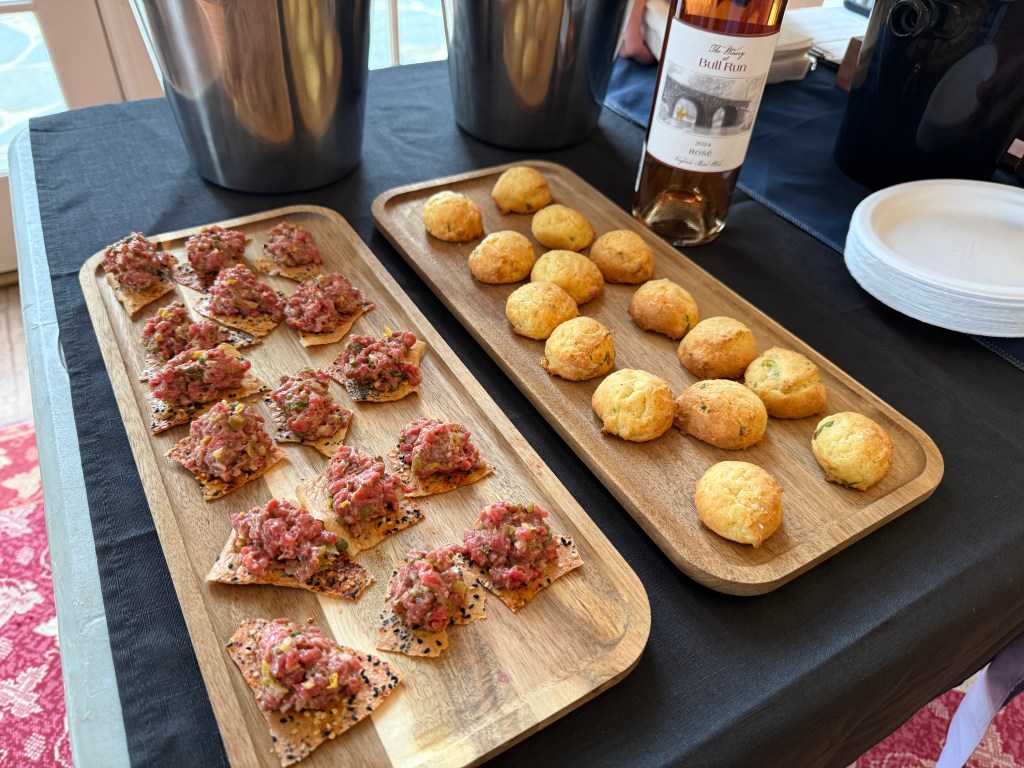
Of course, the highlight was our food and wine pairings. First off was a 2024 Viognier paired with a wagyu tartare, then a savory cheese puff (the fancy name is tallow gougère) to go along with their 2024 Rosé.
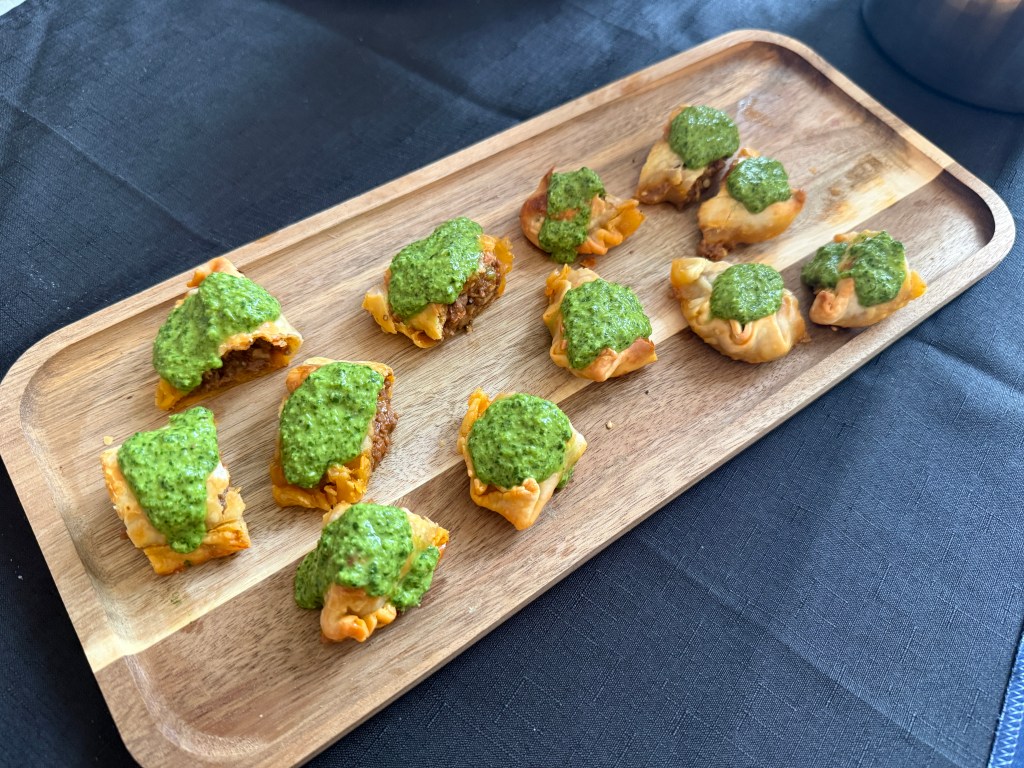
Then came the empanadas – lots of them. The salsa verde was spicy, but we cooled them off with Bull Run’s 2022 Cabernet Franc.
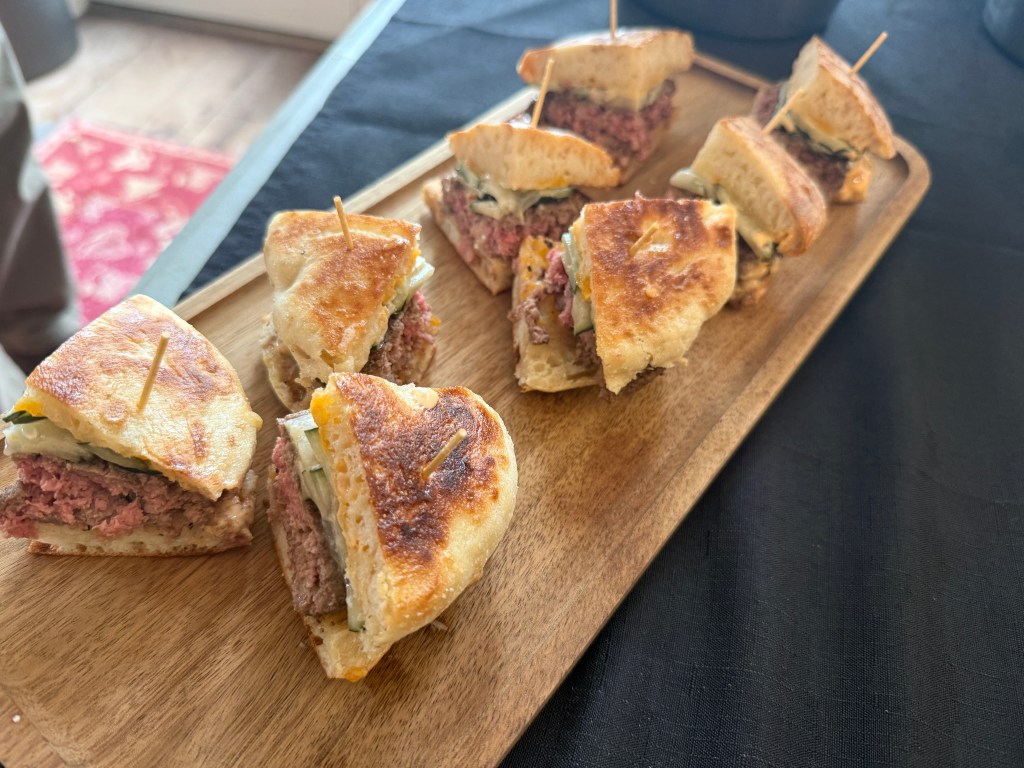
Not surprisingly, my favorite were the beef sliders made with that W1 Wagyu, paired with a 2020 Merlot.
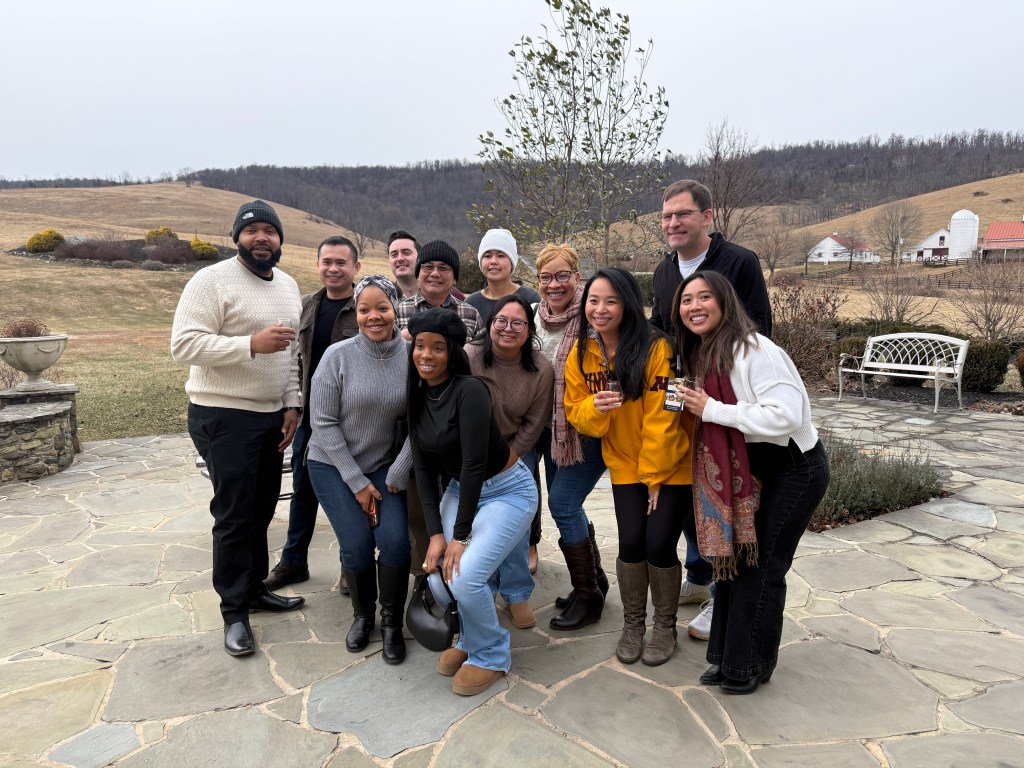
If it hadn’t been so cold I would have walked around outside more – although that didn’t stop the group from some picture-taking.
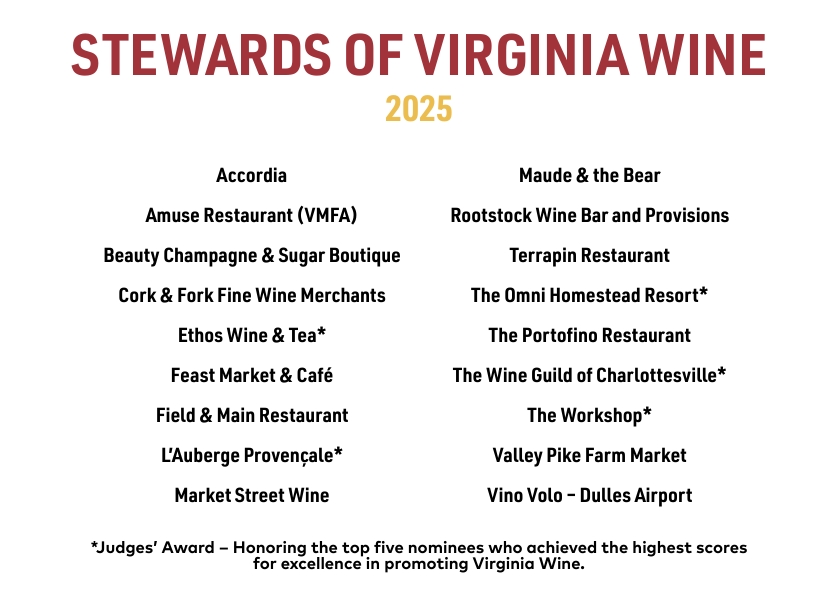
Have you ever looked for a bottle of Virginia wine but didn’t want to drive to a winery to find one? If so, then check out “The Stewards of Virginia Wine”.
This initiative from the Virginia Wine Marketing Office recognizes restaurants, bars, and retailers who have championed the Virginia wine industry. These businesses were rated on criteria such as their partnership with local wineries, presence on shelf space or wine lists, and overall commitment to Virginia wine.
These Stewards play an important marketing role for the Virginia wine industry. In 2019, an economic impact study found only 5.3% of wine sold in Virginia was locally produced. If Virginia is to increase this number, it will need retailers, restaurants, and bars such as these to increase the footprint of the local wine industry.
Sales from these venues also offer a ‘prestige factor’ that is hard to replicate. Horton Vineyard’s 1993 Viognier was the first Virginia wine ever sold at The French Laundry, one of the most prestigious restaurants in the US. This was a marketing boon for the then-nascent Virginia wine industry.
Why Virginia wine is hard to find outside the winery
The lack of availability of Virginia wine is linked to two intertwined culprits: high bottle prices and low production.
Most Virginia wineries make under 3,500 cases/year; only a handful produce more than 40,000 cases. The boutique nature of the business means wineries seldom achieve the economy of scale necessary to compete in the $25 and under market, even assuming they have bottles to spare. Many of Virginia’s most famous wineries price their premium bottles in the $45-$70 range.
These prices make it difficult for bars and restaurants to include Virginia wine on the menu. Around 21% of restaurant sales are from alcohol, according to data from the National Restaurant Association. Given alcohol is such a significant revenue stream, these venues are more inclined to include a less-pricy wine they can markup, rather than try to sell an already relatively expensive (but unknown to consumers) local bottle.
This pricing also makes it difficult for wineries to distribute their wine.
American alcohol sales are governed by the ‘Three Tier’ system of producers, distributors (who buy from wineries at a reduced price), and retailers (who buy from distributors and sell to consumers). The ‘farm winery’ license uses by most wineries allow them to cut out the distributer and producer middlemen and sell directly to consumers. This is why 77% of Virginia wine is sold directly from the tasting room.
Adding those second and third tiers means the winery must sell at a price barely above the cost of production. While some feel the increased exposure is worth the cost, it’s far less profitable for them to take this route.
If that’s not enough, marketing Virginia wine is also challenging. Virginia wine lacks the name-recognition enjoyed by California, Bordeaux, or even smaller wine producing states such as Oregon. Some Virginia winemakers toy with the idea of rallying around a specific grape to focus their advertising, but previous efforts have proven contentious.
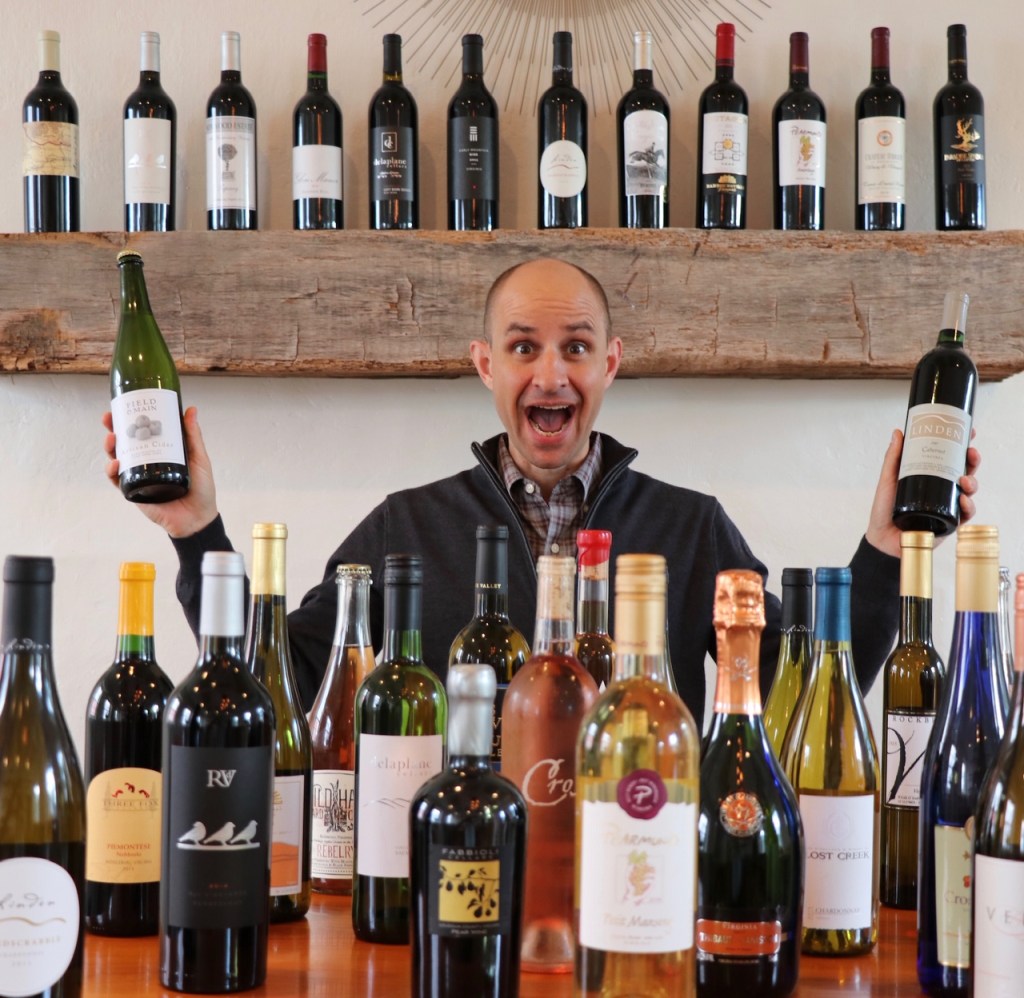
Neil Wavra, owner of Field & Main
Retailers and restaurants a key to industry growth
Even with these challenges, the Virginia wine industry’s future may rest with these restaurants, bars, and retailers. The Stewards of Virginia wine are leading the charge here, but they can’t do it alone.
The VA wine industry’s business model is heavily reliant upon agro-tourism, which inherently limits its audience. If it’s to grow beyond the boundaries of Virginia, these wineries must find a way to distribute their wine.
This will prove challenging. Many wineries are already hospitality-focused venues, relying upon the view and overall experience as much as the quality of their wine. Only a handful can afford the cost of using an intermediary.
Ultimately, it will be consumer demand that allows Virginia wine to rise to this challenge.
When accepting the award for the 2025 Virginia Governor’s Cup, Barboursville winemaker Luca Paschina told the audience, “When you go to your favorite restaurant, you must demand they carry Virginia wine!”. These Stewards are doing their part in advertising local vino, but it’s up to consumers to convince their favorite venues to include wine from the Dominion state.
If I had to pick three words to summarize the Virginia wine industry in 2025, they would be recovering, rebalancing, and evolving.
‘Recovering’ speaks to the impact two years of drought had on Virginia’s vineyards. A full-scale invasion of the spotted lanternfly (SLF), a difficult (and wet) fruit set, and spring frost further depressed tonnage.
‘Rebalancing’ is a reference to a first-time contraction in the number of tasting rooms in the state. Only 3 new tasting rooms opened in 2025 (a 2-decade low), while 8 closed. Eight new wineries are also open for online sales, despite their tasting rooms not being formally open yet.
The combination of declining wine sales and rising production costs made this rebalancing inevitable. Only time will tell what direction the industry goes from here.
That said, there are still bright spots in the world of Virginia wine. While the number of tasting rooms & overall sales have slipped, the number of ‘Virginia wine brands’ grew.
That’s where the last word, ‘evolving’, comes into play.
Many Virginia wineries are changing how they operate to keep up with the times. This means everything from finding ways to attract non-wine drinkers, making winemaking and ownership more accessible, and (in some cases) moving away from the ‘grown at, produced at” model that has long dominated the industry.
With those factors in mind, Virginia ended 2025 with a total of 280 wineries, 35 cideries, and 11 meaderies, plus 36 wine/cider/mead brands that lack tasting rooms. Here is a link to my winery roster.
* This article is entirely my personal opinion and doesn’t reflect the position of the Virginia Wine Marketing Board or any other entity. You can see my previous “Years In Review” for 2020 – 2024.
Enjoying sparkling at Petit Domaine
Tasting-Rooms that opened in 2025
Bandit Ridge Winery (located in Louisa, wine made at James River)
Petit Domaine (located in Hillsboro; wine presently made off-site but will eventually move in-house)
Catamaran Hills (located in Lovettsville; made at Fabbioli)
New Wineries with still-pending tasting rooms, but with wine for sale
Alla Vita (currently has a pop-up tasting room; full tasting room opening in 2026)
Noer Vineyards (tasting room opening 2026, but wine available for sale)
OH’s Vineyard (tasting room TBD but selling wine at other locations. Made at Walsh Family)
Piedmont Meadows (tasting room opening 2026, but wine available for sale)
Silver Dog Vineyards (tasting room opening 2026, but wine available for sale)
Toll Gate Vineyards (tasting room planned for 2026; wine currently sold at a farmers market. Made at Walsh)
Twisted Pines Farm (tasting room open by appointment, but wine available for sale)
WildKind (tasting room opening 2026, but wine available for sale)
Yapita (tasting room opening by appointment. Wine can be purchased at Early Mountain and select wine stores)
New Micro Brands (typically sold via retail or pop-ups)
Garden GroveHedon State (made at Bull Run. BIPOC owned)
Little River (made at Chrysalis)
Nouveau Farms (made at Commonwealth. BIPOC owned)
Novella Wines (made at Commonwealth. BIPOC owned)
Third Culture Kid (made at Walsh)
Zora Chloe Wines (made at The Wine Collective. BIPOC owned)
Wineries and meaderies that closed in 2025
Castle Glen Estate
Garden Grove
Haley’s Honey Mead
Seven Doors Winery
Stanburn Vineyard
Rock Roadhouse
Triple V
Valhalla Vineyards
Vintner’s Cellar of Yorktown
White Hall Vineyards
2025’s Major Stories and Trends
1. The 2025 Vintage: A challenging start with a strong finish
Vineyards started the growing season parched. When the springtime rains came, the rainfall was initially welcomed.
Then it rained some more. And even more. Several winegrowers I spoke with openly wondered if we were facing a 2018-ish vintage, one of the wettest in decades.
The combination of drought stress, SLF, and rain during bloom collectively suppressed tonnage. Some vineyards are reporting yields are down as far as 50%, especially for early budding varieties such as chardonnay.
Fortunately, a warm & dry second half of the season saved the vintage. Many winegrowers are calling 2025 a high quality/low quantity year.
2. Virginia Wine Industry Experiences Its First Contraction…
Three new wine tasting rooms opened in 2025, while 9 wineries (plus a meadery) closed. This means more winery tasting rooms closed than opened for possibly the first time in the modern history of Virginia wine.
A slowdown was inevitable, especially after three decades of non-stop expansion. Changing consumer tastes (especially younger generations abandoning wine) are the main culprit, but tariffs, retiring owners, and a host of other factors also took their toll.
Given 9 new wineries are currently building tasting rooms, it appears the Virginia wine industry still has room for growth. But it’s safe to say we are entering an era where the number of openings and closings will be more closely balanced.
Rock Roadhouse, we hardly knew ye
3. ….But Micro-Brands Seen Opportunity
2025 was a great year for ‘micro-brands’; a term I use to cover ultra-small batch producers. 6 micro brands opened in 2025; a new annual high for this category.
Many of these micro-brands wouldn’t exist without the availability of ‘wine incubators’. Commonwealth Crush, the Virginia Wine Collective, and Walsh Family Wine have led the way here, but multiple wineries have ‘incubated’ a smaller partner at some point.
Incubators fill a crucial role by giving new wine brands access to space, equipment, and (if necessary) winemaking expertise, which lowers the financial bar for them to join the wine industry. This has been especially beneficial for communities that have traditionally had limited representation in the wine world (notably, 4 of 6 of these new brands are BIPOC owned, and 2 have a female owner or co-owner).
There are benefits to keeping a wine brand small. Unlike larger brick-and-mortar wineries, these micro-brands don’t have tasting rooms to manage or vineyards to worry about. Their smaller footprint also means they can better manage inventory.
Perhaps most importantly, the small batch nature of their model means these owners can take stylistic risks a larger brand may shy away from. This has led to some exciting new wines, such as the “What’s This” vidal blanc/petit manseng/chardonel/tannat blend from The Parallax Project (one of my favorite wines of 2025).
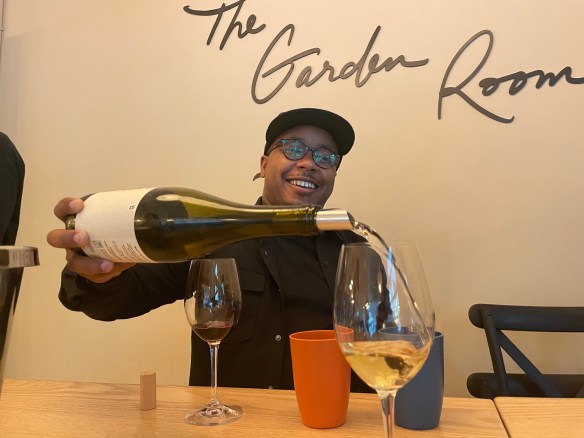
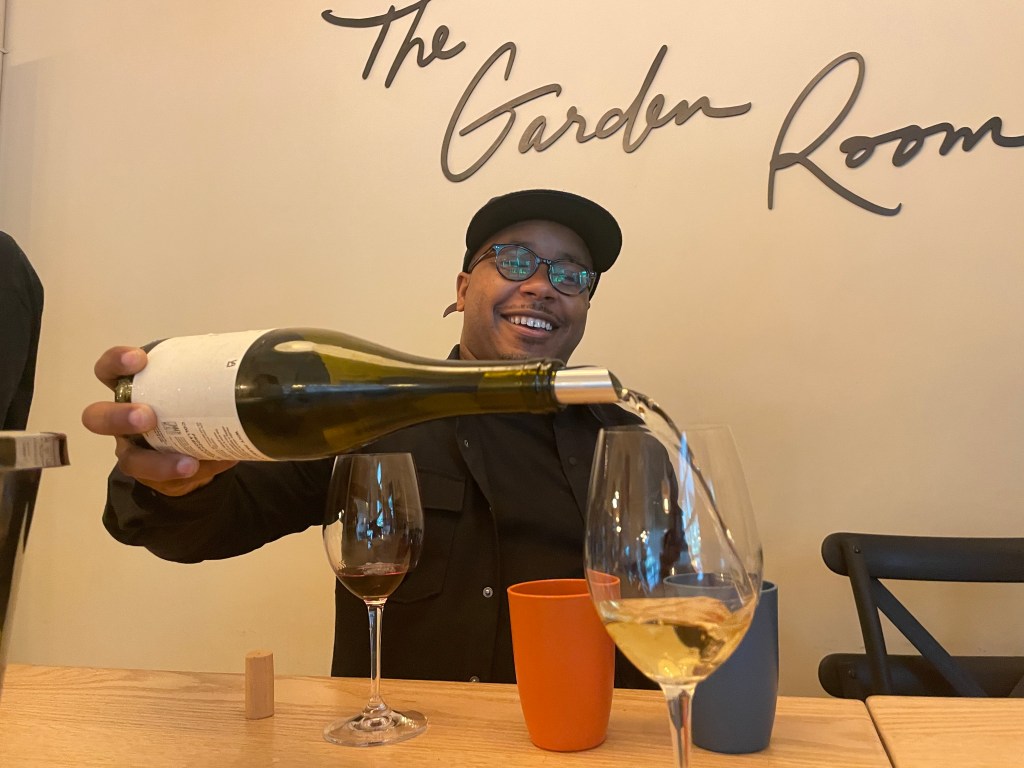
VA wine “Hype Man” Reggie Leonard II pouring “What’s This?”
4. Are More Wineries Embracing Contract Winemaking?
I’m going to be a little controversial here. More places than ever seem to be moving away from the ‘grown at, produced at” model that has long dominated the Virginia wine industry.
My claim is based on data. Only 25% of the 300-ish wineries currently open in Virginia use a contract winemaker. An additional handful rely upon the same small group of consulting winemakers.
Yet if you narrow the data to wineries and wine brands that opened in the past 5 years, nearly half of those (43 out of 92) lack in-house winemaking facilities. Instead, these venues outsource their winemaking to contract winemaker or ‘borrow’ cellar space at another partnering site. Many don’t even have their own vineyards.
Now, I’m not saying this shift is inherently bad. Many wineries don’t have the finances or interest to make wine on-site, manage a vineyard, or operate a tasting room. Micro-brands thrive precisely because they aren’t tethered to such concerns. And who wouldn’t want Nate Walsh or Matthieu Finot to make their wine?
Even so, I’m a little worried over the long-term implications this change portends. If smaller wineries opt to use contract winemakers instead of hiring their own in-house Head Winemaker, this will reduce potential opportunities for new winemakers to enter the business.
Nate WalshMatthieu Finot
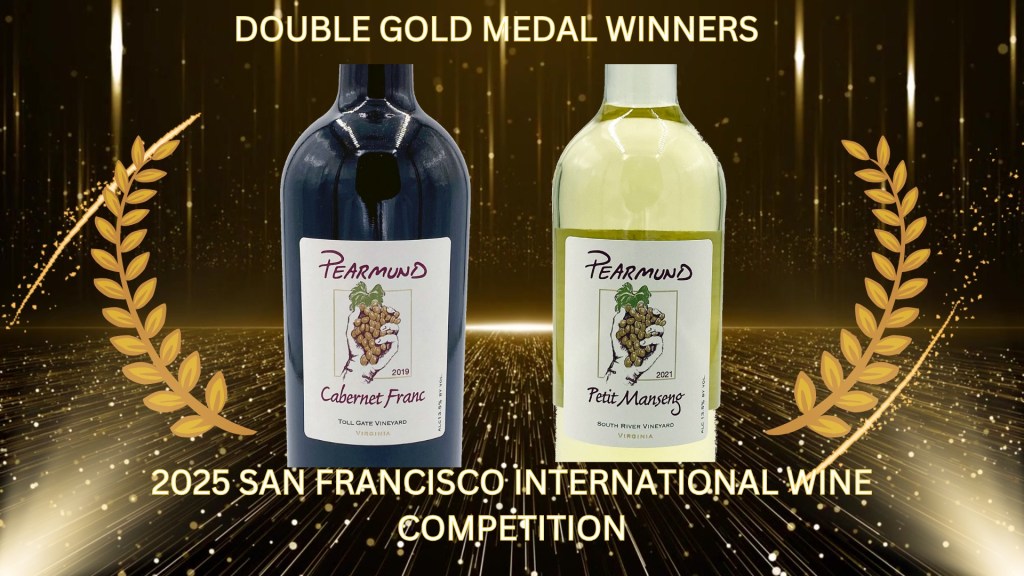
5. Virginia Wine Wins Big In San Francisco: In 2025 Virginia earned an outsized share of medals at two of the most famous wine competitions in the US; the 2024 San Francisco Chronicle Wine Competition (SFCWC) and 2025 San Francisco International Wine Competition (SFIWC). Virginia wine earned a total of 182 medal, including 38 Gold, 22 Double Gold, and a number of ‘Best in Class’ awards. This for a region that makes less than 0.4% of American wine.
This is especially impressive given many of these awards are in very competitive categories, such as sauvignon blanc and cabernet franc. SFCWC wine judge Mike Dunne said of Virginia’s entries, “Each year, some wine region of North America seems to gain recognition for a disproportionate share of high awards at the San Francisco Chronicle Wine Competition. In 2025, it was Virginia”.
These wins are an important way for Virginia to get recognition on the world stage. Click here for a full readoutof Virginia’s performance at the SFIWC and SFCWC.
6. More Events, Beer, and Non-Alcoholic Options Than Ever
A growing reliance upon contract winemakers isn’t the only change going on in the industry. Wineries realize that to attract visitors, they need to offer more than just wine.
As best as I can tell, over 30 wineries now serve beer. Many are also offering a wider assortment of low/no-alcoholic beverages. So far Hark Vineyards is still the only winery producing a N/A wine, but I suspect others are looking at similar options.
Events have also spiked. Virginia wineries have gotten very creative in the events they host, offering everything from charcuterie classes, dancing, painting, and more.
Millennials and Gen Z are a tough crowd to sell wine to. If wineries want to survive, they need to learn to cater to this new demographic.
Honorable Mentions
1. My Favorite Wines of 2025: Click here for my Top 10 list for the past year. Not mentioned but close contenders include Glen Manor’s 2023 Cabernet Sauvignon and 2022 Nebbiolo, and Linden’s 2019 Avenius Chardonnay.
2. Wine thieves and drunk raccoons: OK so this isn’t necessarily about “Virginia Wine”, but these ‘wine-adjacent’ events are so humorous I’d be remiss not to mention them.
First, a pair of thieves stole several bottles of high-end Pinot Noir from L’Auberge Provençale, an amazing restaurant in the lower Shenandoah Valley. Months later, a raccoon got wasted at a Virginia liqueur store. The memes from both are priceless, and many wineries were happy to jump on the meme bandwagon.
3. Sign up for online discounts! Slowing sales means more inventory. And more inventory means more online sales. If you want to stock up, sign up to the mailing list of your favorite wineries and see what kind of discounts they offer.
“Virginia is for (wine) lovers” may not be the official motto for the Virginia wine industry, but it easily could be. The Commonwealth has consistently outshined more famous wine regions, despite making a fraction of the wine they do. Wine writer Mike Dunne, who judged at the 2025 San Francisco Chronicle Wine Competition (SFCWC), said this of Virginia’s entries: “Each year, some wine region of North America seems to gain recognition for a disproportionate share of high awards… in 2025, it was Virginia.”
One of the hallmarks of Virginia wine is its diversity of styles and grape varieties. Cabernet franc and chardonnay are the state’s most widely planted grapes, but Virginia offers everything from albariño to zweigelt.
Two factors shape this diversity: the state’s varied terroir, and a willingness to experiment.
Virginia grows wine everywhere from high-elevation sites in the Blue Ridge Mountains to sandy soils along the Eastern Shore. While the state is arguably a geographic and stylistic middle ground between California and France, winegrowers point out Virginia’s unique growing conditions makes copying either of these areas impractical.
This has led the Virginia wine industry to combine tradition with experimentation. Many winemakers prefer more classic styles that emulate those of the “Old World,” such as Bordeaux or Chablis. Others endorse a more creative approach, sometimes blending grapes normally associated with very different regions of the world.
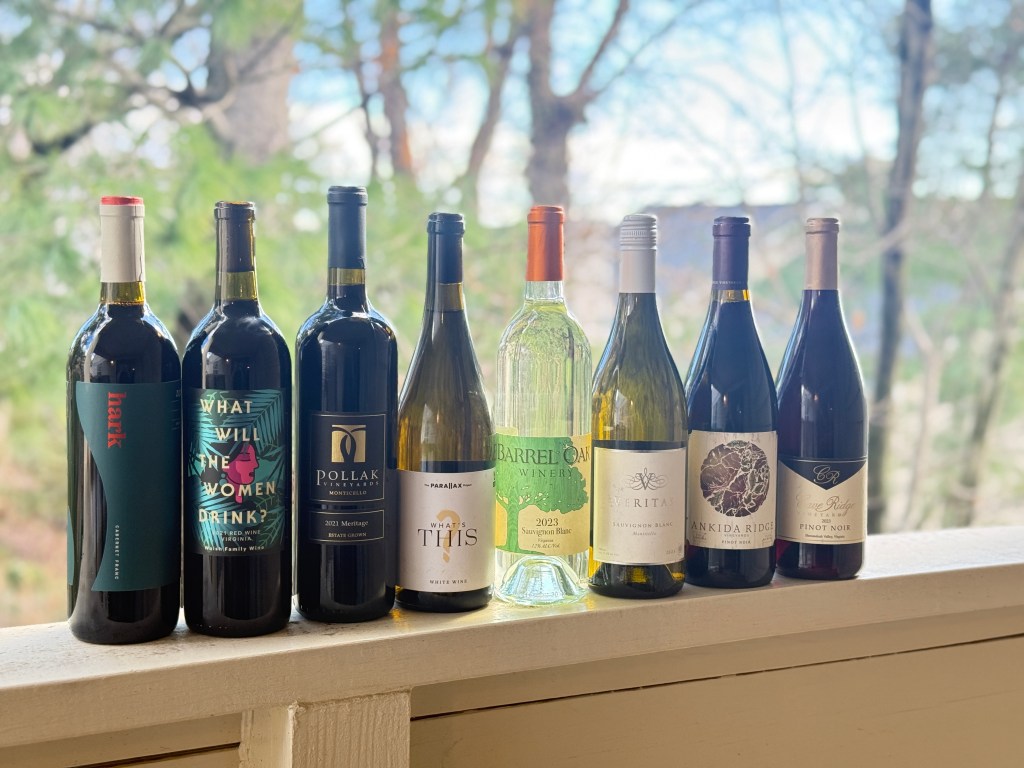
My personal “Top 10” list reflect this veritable hodgepodge of styles. Several are classic expressions of their variety, while others are uniquely ‘Virginia’ in nature. I’m especially interested in wines with great backstories, or varieties not usually associated with Virginia.
1. Ankida Ridge 2022 Pinot Noir ($65): Many vineyards have tried growing pinot noir in Virginia, but Ankida is the first to prove it can be done well. Key to Ankida’s success is its 1,800’ elevation site along the Blue Ridge Mountains, which guarantees moderate temperature swings and low disease pressure.
This wine had a floral nose, with notes of earth, specifically wet dirt. The wine itself had heft but was still well balanced, with just the right amount of oak, tannin, and structure. It also presented tart fruit notes on the palate.
2. Cave Ridge Vineyard 2023 Pinot Noir ($45): Compared to the Ankida Ridge, this example of a Virginia pinot was somewhat softer and more fruit-forward. It had a great initial ‘attack,’ with notes of red plum and cherry, and a dash of almond or marzipan. This wine is even more impressive given its Cave Ridge’s first vintage (and 2024 promises to be even better).
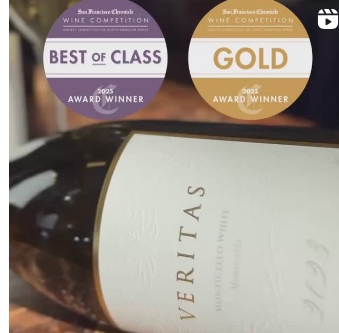
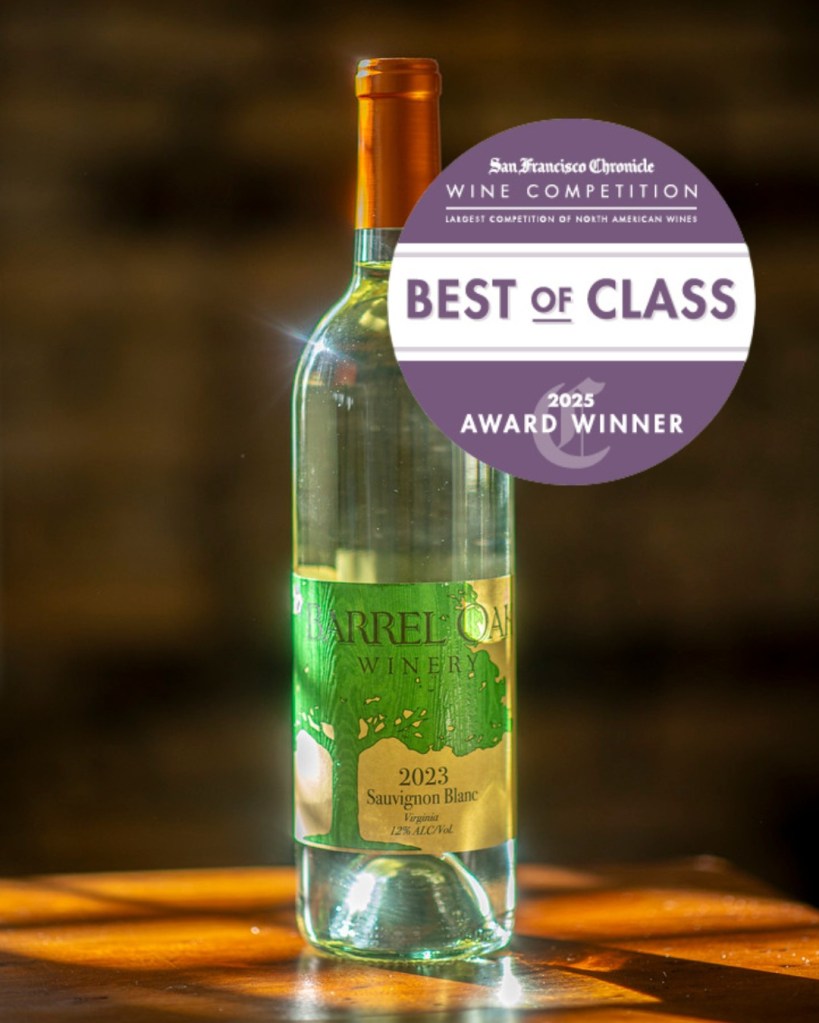
3. Barrel Oak Winery 2023 Sauvignon Blanc ($35): Sauvignon blanc is found all over Virginia yet rarely gets the recognition it deserves. That changed in 2025, when the SFCWC awarded Virginia sauvignon blancs two of ‘Best in Class’ awards, and a 3rd Virginia sauv blanc earned Double Gold. Veritas won in the $30-$34.99 category, while Barrel Oak took the prize for the $35 – and over category.
BOW’s expression wasn’t initially overly aromatic, but it packed a punch on the palate! It was well balanced, full of ripeness, and unleashed a crescendo of tropical flavors including citrus and lemon on the palate.
4. Veritas Vineyards 2023 Sauvignon Blanc ($26): Comparing this wine with Barrel Oak is a study in contrasts. While the Barrel Oak wine is a riper West Coast style, the Veritas is a more Sancerre-style wine. It showcases a complex array of green apple, grapefruit, lime, and some honey on the palate, and almost begs for a seafood pairing.
5. Barren Ridge Vineyards 2021 Petit Verdot ($36): Petit verdot is valued by winemakers for its overall hardiness in the vineyard, and the body and color it adds to wines in the cellar. This bottle from Barren Ridge was smooth and fruit-forward, with notes of cedar, violet, and especially blueberry. It’s as if the winemaker took every stereotype of what petit verdot should be, but amped them up.
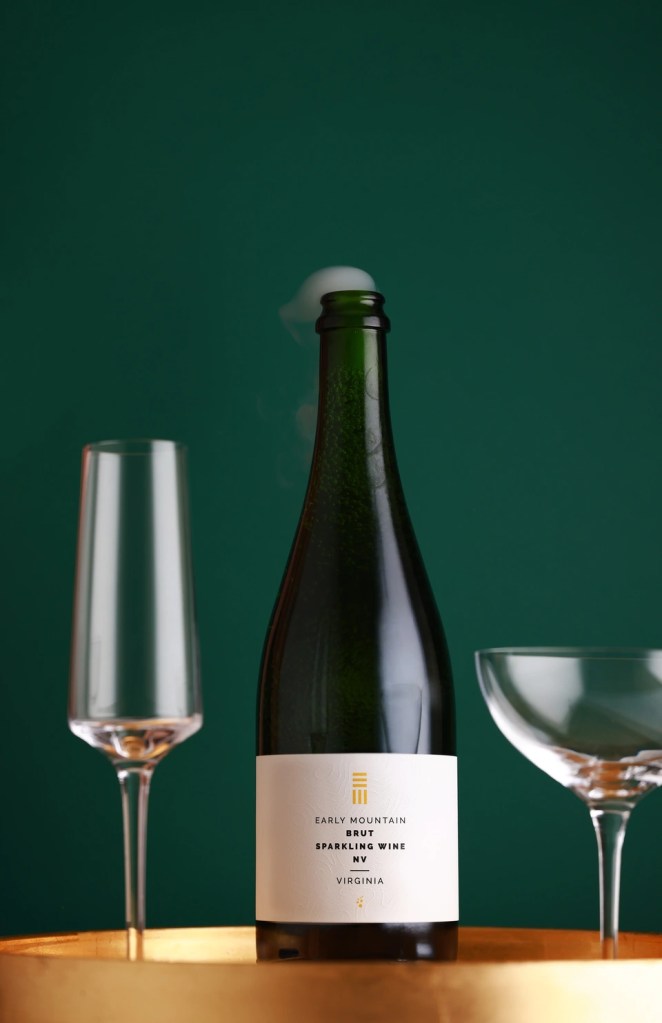
6. Early Mountain Vineyards NV Brut Sparkling ($60): My favorite Virginia sparkling of 2025 is Early Mountain Vineyards’ Brut Sparkling, a blend of 60% chardonnay and 40% pinot gris. Zingy and playful, this wine was full of lemon-citrus notes, with good minerality and a nice finish. I compared this local bubbly with several champagnes, and it was still our overall favorite.
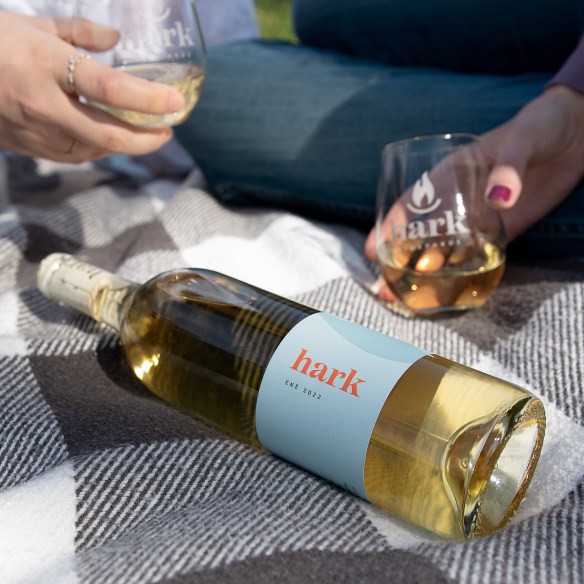
7. Hark Vineyards 2023 Cabernet Franc ($34): The 2023 growing year offered many amazing cabernet francs. So when I say this may be my favorite one of all, that’s high praise. This wine is very approachable already but will cellar for years. I detected aromas of red berries and violets, with red and black cherry and ripe plumb on the palate.
8. Pollak Vineyards 2021 Meritage ($50): How good is this wine? I shared it with a group of DC sommeliers at a blind tasting and half thought it was the event’s Bordeaux wine. A Double Gold winner at the SFCWC, it’s composed of 46% Merlot, 41% Cabernet Franc, and 13% Petit Verdot. Pollak’s red blends are possibly the best-valued Bordeaux-style wines in Virginia.
9. The Parallax Project 2024 “What’s This?” ($30): The Parallax Project is a micro-label that demonstrates what happens when winemakers think ‘outside the box’. This white blend is made from a mix of red and white vinifera and hybrid grapes; 44% vidal blanc, 22% petit manseng, 19% chardonel, and 15% tannat.
‘What’s This?’ has lots of texture, which makes it feel ‘big’ for a white. I found it had bright acidity and a lemon merengue nose. Its counterpart blend, “What’s That?,” uses the same component grapes but made as a red wine.
10. Walsh Family Wine 2021 “What Will The Women Drink?”: If wine competitions gave awards for witty comebacks, “WWTWD” would win hands down. Co-owner Sarah Walsh crafted this big-bodied red wine after a male customer patronizingly implied that females would prefer sweeter beverages. Since then, she’s marketed WWTWD to women and gives a part of its proceeds to women-focused charities.
The 2021 WWTWD is a blend of 45% petit verdot, 40% tannat, and 15% cabernet sauvignon. It’s surprisingly smooth for a tannic blend, with notes of bramble fruit and purple flower on the nose, and black fruit on the palate.
Every December I make a pilgrimage for one of my favorite annual events – Linden’s library tastings.
Linden Vineyards opened in 1987, and owner Jim Law has been careful to hold back a portion of his vintages so he can see how they evolve over time. That’s allowed him to build an extensive wine library, some dating to nearly the founding of Linden. Jim opens up that library every December.
During the Friday I visited, Linden was doing side-by-side tastings of their Boisseau Chardonnay (2014 and 2019), Petit Verdot (2014 and 2016), and Avenius red (2015 and 2019).
Those were great, but the highlight of the day were the ‘bonus pours’ of their 1996 Chardonnay and 2004 Avenius red. Since library wines were for sale, I purchased a 2017 Avenius Chardonnay to share with my group.
Boisseau Chardonnay: Named after Linden’s warmest vineyard, just outside Front Royal. Both vintages were surprisingly fresh and high acid. I typically find Boisseau wines are more hedonistic compared to their higher-acidity cousins at Hardscrabble and Avenius, but the acidity was spot on here. Both wines were really outstanding.
2014 Boisseau. Ripe; lots of green apple, maybe pear? I was told the nose was reminiscent of chamomile tea nose, although I’ll have to take that on trust as I’m not a tea drinker.
2019 Boisseau. More tropical than outright ripe, maybe mango or even a hint of banana.
Petit Verdot. Petit Verdot is the only red wine Linden consistently labels as a full varietal (on rare occasions they’ll also make a Cabernet Franc). But technically, both of these PVs were blends, even if the vast majority of the juice was Petit Verdot.
These wines were also unique in that both had dashes of Carmenere, a variety that Jim experimented with but tore out because it was under-performing.
2014 Petit Verdot (88% Petit Verdot, 8% Cabernet Sauvignon, and 4% Carmenere). Fruit forward. The 12% blending soften it up a bit, so this isn’t a ‘slap you in the face with a blueberry’ PV. I had some sediment at the end.
2016 Petit Verdot (94% Petit Verdot, 3% Merlot and 3% Carmenere). Another soft expression of PV, but for a different reason. While the 2014 was made in neutral oak barrels, this was made in steel to deemphasize the tannin. Jammy, with raspberry notes.
Avenius red. This is Linden’s highest and coolest site. Lately, Avenius wines have been my favorites in side-by-side comparisons, partially because they are more ‘serious’ than wines made from Boisseau (although that 2014 Boisseau was excellent) but can be enjoyed younger than Hardscrabble.
2015 Avenius. Lots of earth with very faint fruit. I have a bottle I should try soon-ish if I’m to find those fruit notes.
2019 Avenius. The primary was there, although it was starting to explore those tertiary notes. I had a bottle in March and my notes then mentioned black fruit and high acidity. I didn’t get as much fruit this time though.
“Bonus pours”
1996 Chardonnay. This was all Hardscrabble fruit, although this was before the time when Linden had separate vineyards. The nose was nutty, and reminded me of a petit manseng. Nutty, caramel palate; layered. I’m in awe that a white wine could last nearly 30 years; I love ‘old’ chardonnays, and would absolutely try this again.
2004 Avenius red. Tart cherry. I wouldn’t call it ‘fresh’ but it wasn’t nearly as faded as you’d expect from a wine that’s over 20 years old. One member of my group mentioned it had an almost balsamic quality to it.
2017 Avenius Chardonnay. I hadn’t had this wine in a long time! Very full, even a little bit tropical.
2025 was the year I began my deep dive into Oregon wine, specifically the Willamette Valley American Vinicultural Area (AVA). I knew Oregon is the 5th largest wine-producing state in the US, and this particular AVA is synonymous with pinot noir. Unfortunately, that was the extent of my knowledge.
I soon learned how terroir-specific Willamette wines can be. The larger Willamette Valley AVA alone has 11 smaller AVAs embedded within its borders, each with their own unique terroir (by comparison, Napa has 16 sub-AVAs, yet produces more than 10 x as much wine).
I also didn’t realize Oregon is an up-and-coming sparkling wine producer, with production more than doubling since 2022. To better promote this trend, in July 2025 Oregon producers banded together for the inaugural launch of “Method Oregon”, which featured over 50 sparkling wines made in the Méthode Traditionnelle.
One winery that showcases both of these revelations is Trisaetum Winery, located about an hour SW of Portland. Trisaetum also makes sparkling wine under its Pashey Wine portfolio.
While the winery is in the Ribbon Ridge AVA, Trisaetum also has vineyards in the Dundee Hills and Yamhill-Carton AVAs. They make both vineyard-specific wines and ones that combine all three sites, with pinot, riesling, and chardonnay planted at each (plus some gamay at Ribbon Ridge, and pinot meunier at their Yamhill-Carton site).
Founder James Frey must get a lot of inspiration from his family, since he named both labels after family members. “Trisaetum” is a merger of the names of his two children, Tristen and Tatum. “Pashey” is named after his grandmother, a Romani woman who accepted exile from her community so she could marry James’ grandfather (her photo is tagged to the cork).
My friends and I enjoyed two wines from Trisaetum; their 2023 Willamette Valley Pinot Noir, and their 2021 Pashey Estate Cuvée sparkling.
2023 Willamette Valley Pinot
This bottle is one of Triseatum’s multi-AVA wine. We found it had a ripe-sweet nose with notes of cranberry or purple flower, perhaps accompanied by some black or red cherry, even candied plums.
I thought it had a light earthy palate with soft notes fruit, especially those candied plums again. Those fruit notes were backed by silky smooth tannins, a good mid palate, and some spice notes to accompany a long, persistent finish.
Wine critics note that Oregon pinot is reminiscent of Burgundy, but I think that’s both a compliment and a crutch. I think wines like this demonstrate Oregon doesn’t need the validation of being compared with Burgundy, no matter how high a praise that may be.
Winemaking details: 57% whole cluster press (for added tannin), aged 10 months in 17% new French oak, blended from fruit from all three estate vineyards.
Photo credit: Trisaetum Winery
2021 Pashey EstatesCuvée
This wine is red fruit driven, on the nose and palate. For me, raspberries were prominent on the initial ‘attack’, with a finish that was more mineral driven. My friends had additional notes of their own, with notes of chalk or allspice thrown in.
The winemaker was extremely restrained on the dosage. If you prefer very dry sparkling wines, this is a great choice (I later looked it up and was unsurprised it was only 3.0 grams per liter).
Winemaking details: 72% pinot noir, 14% chardonnay, 14% pinot meunier sourced from all three estate vineyards. It had 3.0 g/L, putting it in the Extra Brut range (translation: it’s pretty darn dry).
One downside of living in Virginia is small west coast producers don’t have a lot of local distribution, so your best bet is to purchase online.
Virginia is enjoying a sparkling wine renaissance, especially in NOVA. A sparkling wine house named Petit Domaine recently opened in Loudoun, Stinson Vineyards has recently introduced a sparkling label named Lido Deck, and Stone Tower now has an entire facility dedicated to producing bubbly. These are just a few data points on what looks to be a shift from lower-cost sparkling formats such as pet-nats and charmat-style wine to higher-end, more ‘champagne’-style sparkings.
“High end” may be a bold statement. Champagne is still the default setting for high-end sparkling wine, and Virginia’s terroir is radically different from the world’s most famous sparkling region.
Moreover, I still think many Virginia sparkling producers are still tweaking their game. With the exception of a few standouts (looking at you, Thibault-Janisson, Trump Winery, and Veritas), most Virginia sparkling producers have only recently joined the ‘méthode traditionnelle’ club.
Most of these higher-end bottles price around $60, with Early Mountain Vineyards and Trump Winery amongst the most notable producers in this price range. Consumers can also find good quality $35-40 bottles from Thibault-Janisson, King Family, and broader cast of wineries.
Tasting & Scoring Methodology
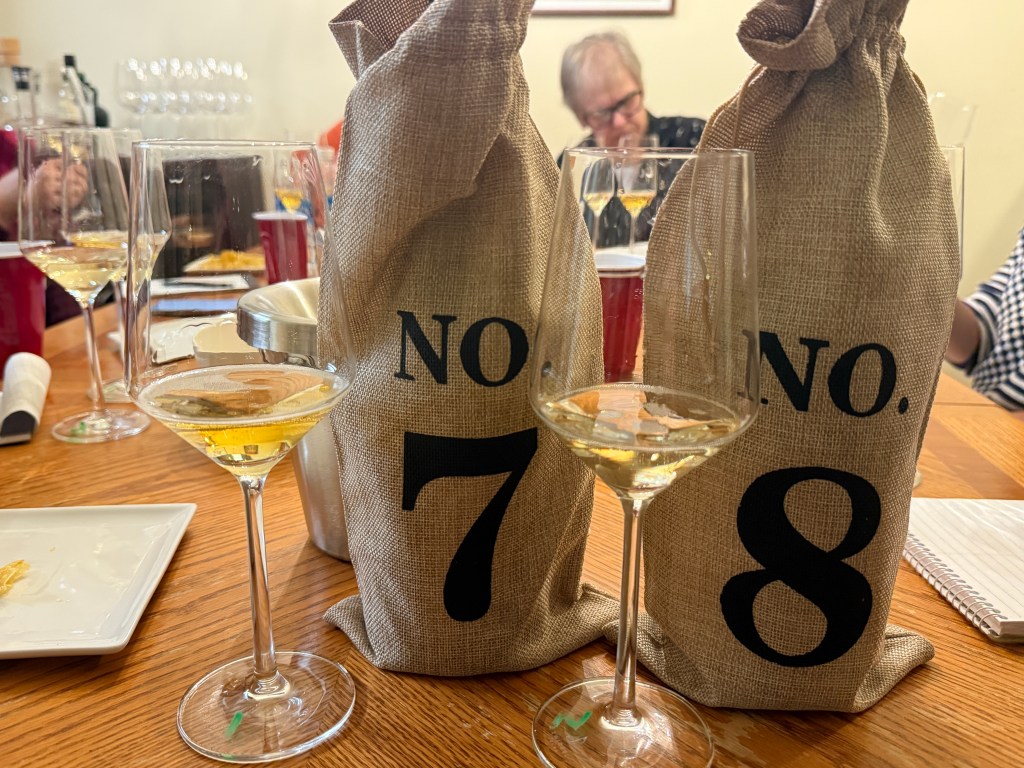
A group of friends & I blind tasted 8 wines in 4 flights. All the flights were bagged.
To make it even more challenging, we mixed the French and Virginia wines up. This meant our rounds included France vs Virginia, Virginia vs Virginia, or France vs France, all depending on luck of the draw. After the last pairing, we voted on a “Top 2” from these 8 to go into the finalist round (as a last-minute change I added the 3rd favorite to join these finalists).
This mixing had the unexpected benefit of preventing us from obsessing over “Which is Virginia?”. We ended up spending more time on the actual wine, and less worrying where it came from.
I didn’t use a fancy scoring system. I did ask which was the favorite per round, but the goal was always to choose the “Top 2” of the day.
When I created this event, I specified the French sparklings be in the ~$50 range (although one of them was in the ~$70 range) and the Virginia bottles in the ~$60 range. This meant the comparing French bottles were lower-end champagnes and one higher-end cremant. I gave Virginia a higher price-point to account for how these are more boutique operations.
I figured this price range would even the playing field, keeping out the higher-end Champagnes but still having some strong contenders.
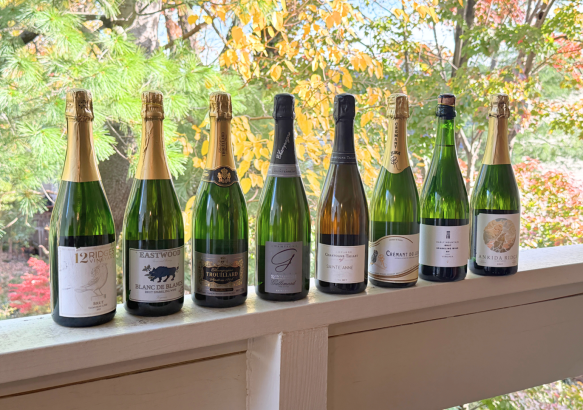
I ultimately selected 12 Ridges, Early Mountain Vineyards, Eastwood Farm (using a sparkling made by Thibault-Janisson), and Ankida Ridge, since these haven’t been in my earlier blinds.
All the participating bottles made in the traditional method, although the blends often differed.
The Contenders
Crémant du Jura “Harmonie” by Domaine Pierre Richard (Jura; 100% Chardonnay; ~$30)
Bottle #1: Crémant du Jura “Harmonie” by Domaine Pierre Richard (0 votes)
Bottle #2: Ankida Ridge Brut (7 votes)
Our opening round was France vs Virginia. I wish the Ankida had gone up against a higher price point wine, but such is the nature of blind tastings that it randomly went up against the cheapest French wine in our group.
Bottle #1/Crémant du Jura “Harmonie“ by Domaine Pierre Richard: Lots of apple notes, including bruised apple, specifically yellow or green apple. Someone mentioned it was soft; maybe even tropical. Lower acidity. It was “pithy” and had a shorter finish.
Everything about this wine was on the up-front ‘attack’. If anything, it reminded me more of a sparkling cider than a sparkling wine.
Bottle #2/Ankida Ridge Brut: There was some funkiness on the nose initially, but that soon blew off. This wine had a longer finish, and presented as tart, with notes of toasty white bread, maybe back by some oak. We also found orchard and pear notes. Someone mentioned a hint of nutmeg.
#2 was higher in acidity than #1 but was not a tremendously high-acid wine. It was structured and ‘old world’ in nature. This also had a big initial ‘attack’, which isn’t the style some of us enjoyed. Comparatively speaking, we enjoyed this much more than #1.
I will say that while we *liked* this wine, we didn’t *love* it initially. We later discovered it needed time to open up, which made all the difference. When we re-tasted, especially with food, we liked this wine far more.
Bottle #4: Trouillard Brut Extra Selection (7 votes)
This round was a Champagne vs Champagne event. We enjoyed these two wines more than the previous round, at least on the first sips (although we later decided we enjoyed Ankida Ridge’s Brut more than the Gallimard).
#3 was a softer expression of sparkling wine; more like the kind of wine you bring to a party that everyone will likely enjoy it.
Bottle #3/Champagne Gallimard Quintessence: Blue cheese-like nose? This wine was YEASTY, almost pungent. Someone mentioned “antibiotics on steroids” on the palate. Another mentioned caramel corn or butter. Another said it had a bruised apple nose. Maybe notes of yellow apple on the palate.
On the flip side it had good balance, plus was fresh and clean. Everything was ‘up front’ for this wine.
Bottle #4/Trouillard Brut Extra Selection: Notes of ginger. Lots of positive notes including balanced, elegant, and layered. Flinty. Someone mentioned notes of strudel or pastry. Bright, maybe some honey on the nose. Another mentioned this was red fruit-driven.
This bottle also had more of the traditional autolytic characteristics you’d expect in Champagne, something we hadn’t seen thus far. We suspect it had a bit of age to it as well.
Flight #3
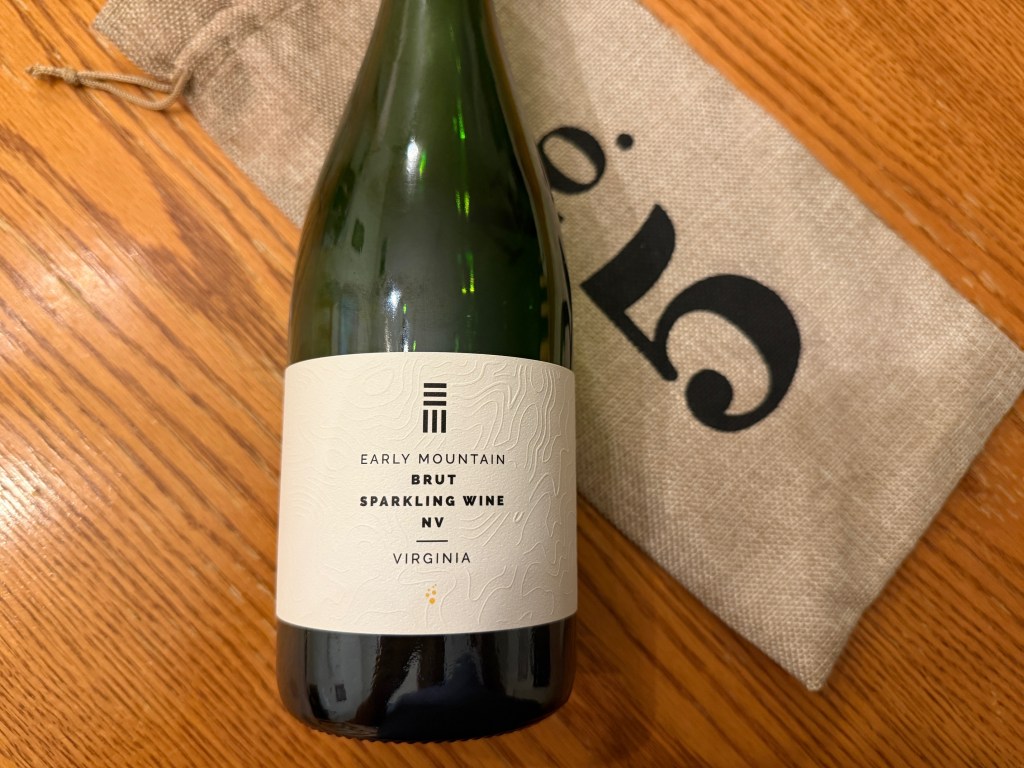
Bottle #5: Early Mountain Brut Sparkling (7 votes)
Bottle #6: Chartogne-Taillet Cuvée Sainte Anne Brut NV (0 votes)
The bubbles on both of these were FROTHY, especially #5. This was probably our highest-rated round of the day, although in this pairing we universally favored #5/Early Mountain.
Bottle #5/Early Mountain Brut Sparkling: Zingy; very bubbly and lively. Lemon-citrus notes; someone mentioned dragon fruit. Notes of citrus, but a ripe citrus. Good minerality and nice finish. Someone guessed it may have gone through a partial malolactic fermentation, but just a guess.
This was also a crowd pleaser of a wine, although it had lots of positive notes for wine snobs. One guest described this wine as ‘playful’, and I think that was the best description so far.
Bottle #6/Chartogne-Taillet Cuvée Sainte Anne Brut NV: Yeasty. Notes of pair; anise was also mentioned. High acidity and very bright. Notes of baking spice, even smoke, was mentioned. It seemed slightly on the higher alcohol side.
The flavor profile was very up front. Very rich; maybe backed by some oak? But overall, this wine was defined by its acidity. This was the most expensive Champagne of the day, so I’m glad it was compared to the EMV.
Flight #4
Bottle #7: Eastwood Blanc de Blancs (2 votes)
Bottle #8: 12 Ridges Brut (5 votes)
This round was Virginia vs Virginia. It also compared two very different wines; a moderately-priced Blanc de Blanc vs a higher price point from a unique vineyard situated at 3,300’ feet elevation.
Bottle #7/Eastwood Blanc de Blancs: Deep straw color. At least one guest mentioned a “fresh bread nose”. Several mentioned notes of spice, even turmeric. It was heavier bodied; maybe with a popcorn-quality to it. We suspected this might have been made in a warmer climate.
Initially we didn’t love this wine, but as it opened up we started to appreciate the richness of it more.
Bottle #8/12 Ridges Brut: Very clean and balanced, with a nice finish. Citrus palate. Good floral notes; reminded us of fresh flowers, even dried flowers.
One guest described it as a ‘baby champagne’, since it had all the notes you’d want in a champagne, but they were still learning to express themselves. Lots of potential here. Maybe it needs more time.
Finalist Round
Bottle #2: Ankida Ridge Brut (3rd place)
Bottle #4: Trouillard Brut Extra Selection (2nd place)
Bottle #5: Early Mountain Brut Sparkling (1st place; overall winner)
I asked my guests for their “Top 3” favorites. I used data to narrow it down to two finalists, which we would retry.
Top 3 going into the finalist (but not the actual final vote)
#4/Trouillard and #5/Early Mountain Vineyard were universally our top 2 picks. But picking a 3rd choice was difficult because these 3rd choices were a very distant preferences to the Top 2. I struggled to find a clear 3rd favorite myself.
Then I did something I’ve never done before. We put #4/Trouillard and #5/Early Mountain aside and started sipping the remainder of the wines. At that point, I realized #2/Ankida Ridge had totally changed.
At this point the Ankida was practically a different wine. So much so that if this was how it initially tasted, I may have selected this over one of my other picks. We liked it so much I put it into the finalist round, making it a trio of ‘finalists’.
After our food break we did a final tasting and voted. Here was the breakdown.
Finalist round (Listed as the judge’s Favorite, Second Favorite, and Third Favorite)
Several guests who initially voted for #4 switched to #5 (Early Mountain). I’m not sure if the Early Mountain got better or the Trouillard started dying off. But we just loved Early Mountain even more in the finalist round.
Early Mountain’s Brut was the event winner.
Lessons Learned
I admit it; I wasn’t sure how this would play out. Topping Champagne in the sparkling category is a tall order. I made sure to exclude super high-end Champagnes to even the playing field, but even Champagne’s $50-range should have been hard to beat.
So imagine my surprise when Virginia came in with the 2 of the top 3, including the winner.
I have to give credit where credit is due. Early Mountain Vineyards makes exceptional wine. While it’s not known as a sparkling house, good winemaking goes a long way, so I shouldn’t be *too* surprised.
Ankida Ridge is another exceptional producer, plus they also have a very unique terroir. That shined through here. I love that the Vroomans came in as our 3rd pick.
When it comes to good sparkling, I’m a believer that there is a measurable difference between what you get in the $50-range vs the $75-range. This event gives me confidence that Virginia can compete against these lower to mid-priced Champagnes.














 Wine Trails and Wanderlust